Postcards from Amsterdam, Netherlands: ‘Stories that Matter’ told by the brave

Above: Names of journalists and photographers killed in the line of duty memorialized at the opening exhibition of the World Press Photo 2024 Awards in the Nieuwe Kerk Amsterdam

In the two decades since 2003, at least 1,668 journalists have lost their lives while trying to shed light on issues of importance to us all, according to Reporters without Borders. In 2023, another 45 names were added to that list. The list prominently displayed in Amsterdam’s New Cathedral for the opening of the World Press Photo 2024 Awards must have hit the photographers hard – names of coworkers and friends they have made while covering stories in danger zones throughout the world.

The Nieuwe Kerk is hardly “new,” having been consecrated in 1409. While the “Royal Church” is still used for royal weddings and coronations, it also serves as a venue for important exhibitions, such as this one. With its soaring vaulted ceiling, floors embedded with tombs and cherubs overlooking all, the dramatic setting emphasized the seriousness of the meaningful topics delved into by the award-winning photographers.

Continue reading “Postcards from Amsterdam, Netherlands: ‘Stories that Matter’ told by the brave”

Postcard from Oaxaca, Mexico: Ceramics, film posters and photographs fill former convent

Above, plate by Rafael Jimenez on exhibit in “Ceramica de la Familia Jimenez” at Centro Cultura San Pablo

Opening his own workshop in Oaxaca in 1925, Ignacio Jimenez soon realized that the talavera technique he had learned for applying paint did not work with the finer clay he desired using. Seeking a solution, he developed a new method for adding decorative designs and color to clay – ceramica escurrida, best translated as “drained” ceramics.

The skills he perfected were passed on to his wife and children, and his distinctive style continues to flourish as the Taller de Ceramica de la Familia Jimenez. His children employ the technique to create traditional patterns as well as their own more contemporary artistic designs.

Continue reading “Postcard from Oaxaca, Mexico: Ceramics, film posters and photographs fill former convent”

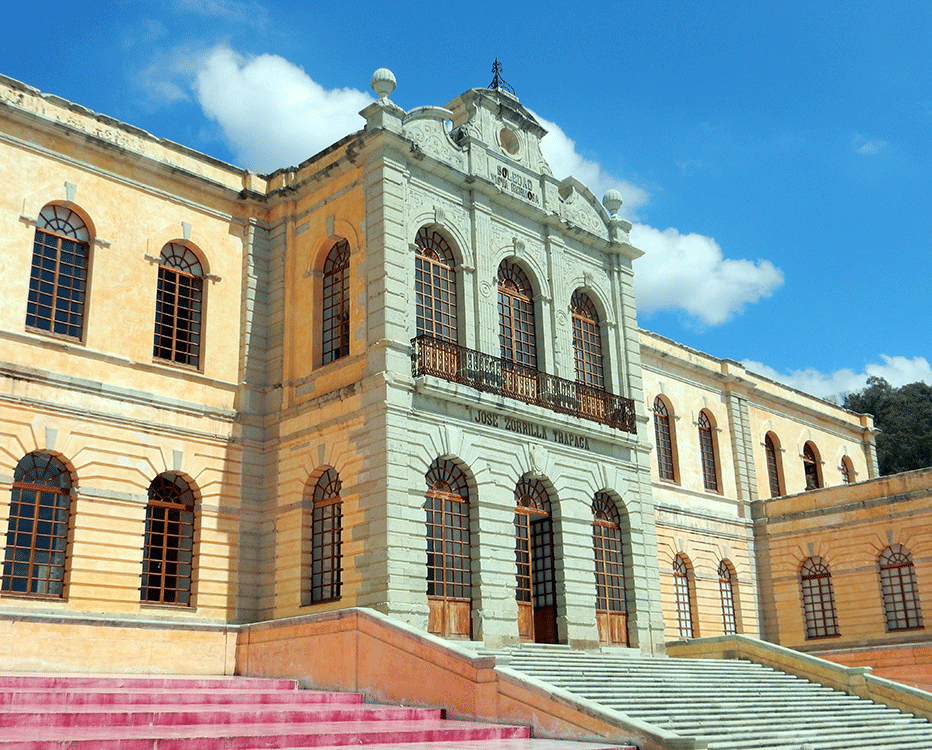
Postcard from San Agustin Etla, Oaxaca, Mexico: Former factory rehabilitated as center for the arts

As someone who grew up going to school in one of those flat-roofed, aqua-paneled elementary schools built in an aesthetically-impaired period of the 1950s, bumping into architectural gems in rural Mexico is always amazing to me. Isolated from its surrounding landscape and thrown into the midst of photographs from around the world, the photo above would be difficult to place. But not only was this handsome structure built in 1883 in rural Oaxaca, its functional purpose was not to serve as a palatial retreat. It housed a spinning and weaving factory – Hilados y Tejidos La Soledad Vista-Hermosa.

In 2000, the shuttered factory in San Agustin Etla was reclaimed by artist Francisco Toledo, who had founded Arte Papel Vista Hermosa nearby two years earlier. The artist purchased the property to serve as an ecologically based arts center. With public and private funding underwriting its adaptive reuse, the property opened to the public in 2006 as the Centro de las Artes de San Agustin, or CASA.

A retrospective exhibit of photographs of Mary Ellen Mark, who died this past year, is currently on exhibit in the lime green Galeria del Chalet perched above the former factory.

In 1991, film director Louis Malle described Mark’s work in Rolling Stone:

Because she is so intensely involved with her subjects, because she gets to know them intimately, because she loves them, she often reveals in one single shot their history, their emotions, their souls. When she photographed runaway boys and girls in the streets of Seattle, she spent so much time with them that her portraits project a disturbing intimacy, a powerful bond between the camera and the children. Strangely, some of the photographs seem like self-portraits…. she knows how to find the perfect angle, the exact fraction of a second that will tell the story in one shot.

Not only did Mark leave behind a legacy of remarkable photographs, but she left her imprint on the work of the hundreds of photographers she taught through the years. She led workshops in Oaxaca for more than 20 years, and we were fortunate to catch an exhibition of some of her students’ works at the Centro Fotografico Manuel Alvarez Bravo in Oaxaca as well.