The contrast of edgy modern art housed within colonial-era walls is always striking, but even more so at Hecho en Oaxaca, an exhibit bringing urban art into the Museum of Contemporary Art, or MACO, in Oaxaca.
This slideshow requires JavaScript.
As a linguistically challenged blogger, translating websites from Spanish to English to conduct my own research would not be a reliable option. Instead I’ll rely on Carole Turkenick’s words from her Oaxaca Tips (a great, inexpensive resource to pick up at Amate Books the second you arrive in Oaxaca) relay the late-17th or early-18th-century building’s history:
The mansion initially belonged to the noble estates of the Pinelo and Lazo de la Vega families whose coats of arms are engraved in the stone façade on either side of St. Michael Archangel. Following Independence, the structure passed through a series of private owners including in the early 1900s a professor at the local Institute of Sciences and Arts who had the distinction of owning the first automobile in Oaxaca. By the 1970s, the building had seriously deteriorated and was taken over by the state to be converted into a museum of colonial history. The effort failed and the mansion passed to a local civil organization led by Francisco Toledo who together with the National Institute of Fine Arts opened the MACO in 1992. The building was restored again in 2009-2010,
The magic of the first carpet had our attention. And the second. Brilliant colors, traditional patterns passed from wrinkled hands to nimble young fingers generation after generation in villages in the interior of Mexico.
Santiago Borja’s carpet appears traditional at its heart but melts into modernism at its edges. Weavers from the workshop of Jeronimo Hernandez in Teotitlan del Valle, Oaxaca, completed its execution.
But then something happened on the next wall. The scarf escaping from the flat surface, its fringe fluttering free as though a butterfly freed from its cocoon…
This slideshow requires JavaScript.
…a phrase too obviously transitioning to the title of the exhibition at the Museo Textil de Oaxaca – Cocoon Me from My Feet Up: Traditional and Contemporary Carpets. Curator OlgaMargarita Davila assembled work by 18 artists from four countries “to connect ourselves with the meaning of the fabric we inhabit: our body.”
Bodies resembling dancing Guatemalan worry dolls bob along the top and bottom of a linear weaving by Susan Martin Maffei whose website explains:
Crocheted 3 dimensional trims, quipus and found objects enhance the narrative visuals of many works, influenced by textile forms and embellishments of the many ancient cultures I have explored.
An “unwrapped” piece caught my eye, but then the artist almost cheated to make me a fan – a postcard. He created a postcard to the curator to accompany one of his pieces.
….there is such a contribution to be made by adapting examples from the history of our chosen medium and quietly exploring a simple form or image through line, grid-form or in separate units, repeating and developing it again and again.
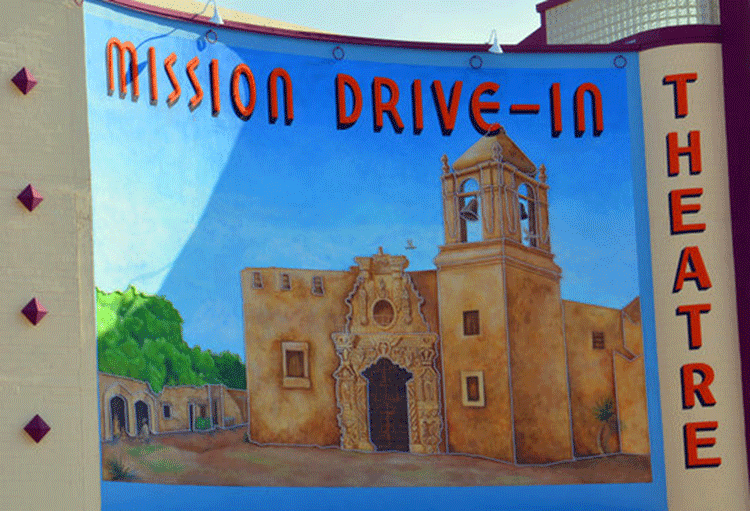
When completed the Mission Drive‐in Theatre will serve as an icon for preservation and neighborhood re‐development….
The project goal is to complete the approved mural components of the Historic Mission Drive‐In Marquee in a way that follows recommendations of the Secretary of the Interior’s Standards for the Treatment of Historic Buildings, and stays consistent with the historic period….
…all viable methods of re‐creating the mural, sign lettering and lighting feature will be considered, provided that the completed work re‐creates the style, color and graphic quality of the original mural and components as closely as possible.
The resulting illumination of the marquee mural instantly makes the old Mission Drive-In Theatre a striking night-time landmark on the south side.
Public Art San Antonio
But there is something missing.
KENS-5 TV
The new mural is soul-less, devoid of the human presence that characterized the original.
Instead of a re-creation, the design was sanitized following public protests in several contentious meetings.
A sombrero-porting Latino leading a donkey, a beast of burden sparing many a worker from debilitating back injuries, and one napping under a sombrero are both regarded as racial stereotyping.
I concede there was a time when many Anglos viewed such images and uttered the racial slur “lazy Mexicans.” Call me naïve, but I like to think we have moved beyond that point.
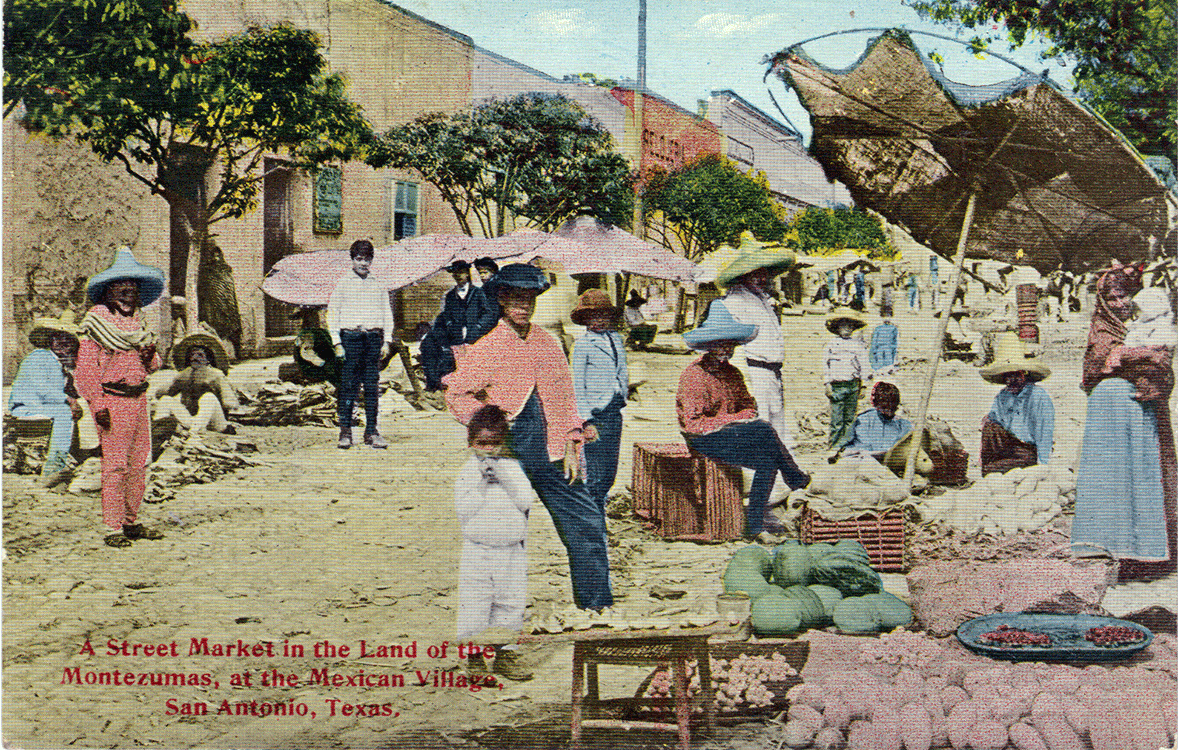
Sombrerería in Mexico City, late 1800s, Underwood & Underwood stereoview card: “The ordinary sombreros are made of palm-leaves and straw, but those of the wealthier classes are of expensive felt, and may be white, gray, or maroon in color. They are often very ornate, being embroidered with the wearer’s monogram, or designs of flowers, and faced with gold or silver lace. In Mexico, only the men wear hats, and they are a very valued possession. Sometimes a man will invest his entire fortune of thirty or forty dollars in his sombrero. They are frequently of vast dimensions. The larger the sombrero, in fact, the greater its aesthetic value in the eye of the average Mexican. The flourish with which he doffs it in salute is something never to be forgotten by the unaccustomed foreigner.”
My hope is, rather than erase the existence of sombreros from our collective memory, we honorably embrace them as part of our heritage in San Antonio.
Here is why:
San Antonio was part of Mexico for longer than it has been part of the United States.
Mexicans who worked outside in the hot sun wore sombreros. They were smart.
The crown of a sombrero can be angled to follow the sun like a sunflower, shading both the face and the neck.
Hardworking people who rose long before the sun and worked until after it went down could use their sombreros for shelter while taking well-deserved naps.
People who sport gimme caps get red necks. No additional comment necessary.
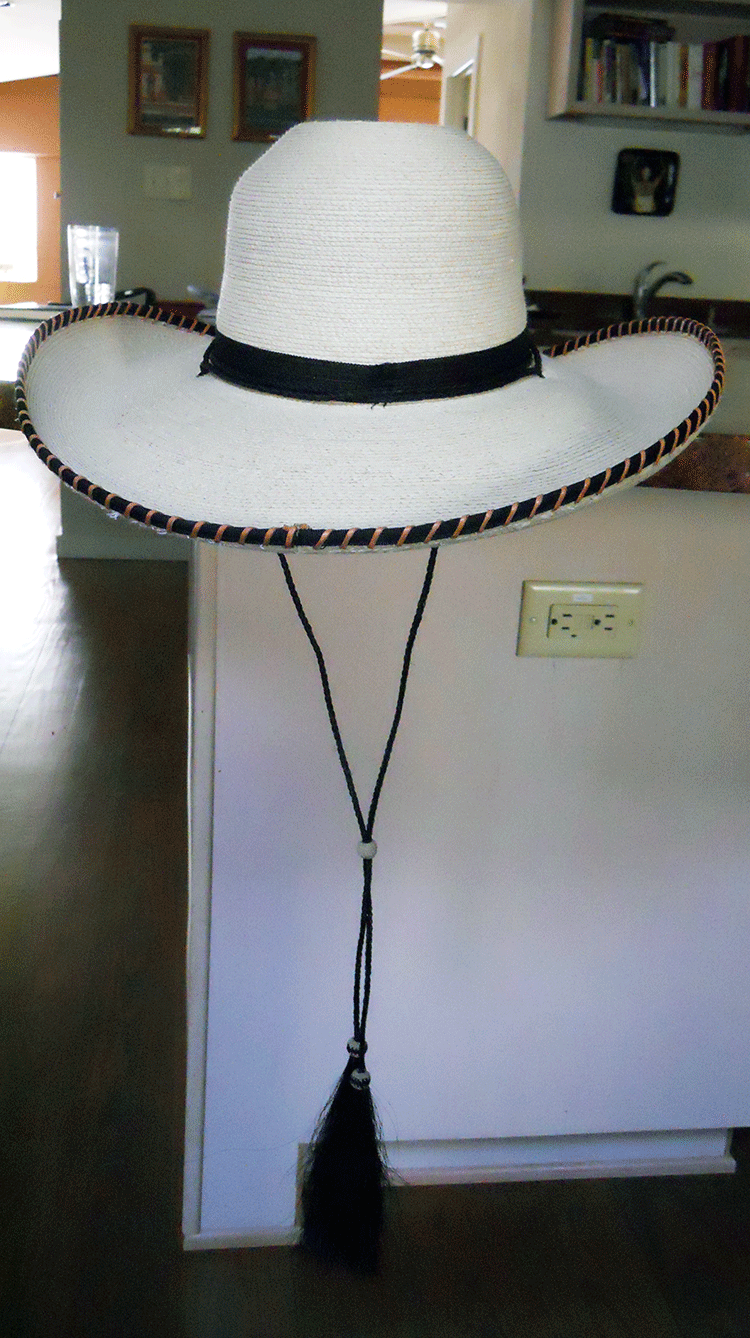
mi sombrero guapo
I’m all for a sombrero resurgence. I’m doing my part.
Yes, I know this aging gringa looks foolish wearing her broad-brimmed caballera hat, complete with a horsetail-hair stampede string to hold it in place when the wind threatens to send it swirling.
But time has taught me a few things. I grew up on a beach trying to keep up with tan people. I merely burned and freckled. A slow learner, I repeated the process over and over, summer after summer.
I’m part of a freckled race that old Dr. Pipkin said had no business south of Ireland. But I hate cold and love hot sauce.
Because I was not wise enough to learn from experience, I had, what I told the Mister was in his honor, an upside-down, backwards “L” carved in my chest. But that “L” actually represents the third letter of melanoma.
I’m only telling you this so, when you see me wearing my caballera hat walking along the Mission Reach, you won’t make fun of me in front of me. My sombrero represents a self-preservation technique I learned from old postcards, from photos of men like those who used to grace the Mission Drive-In marquee.
And, yes, some of the postcards were condescending in tone. But the photos were of real people, real people living in San Antonio who wore sensible hats when going about their daily business.
At this latitude, the sombrero-toting figure appears the smart one. Having a red neck is no sign of intelligence; it’s just asking to be branded with one of those “L’s.”
If only I had one of those back-saving burros to port that case of two-buck Chuck up to the kitchen….



 Postcards from Barton Springs