
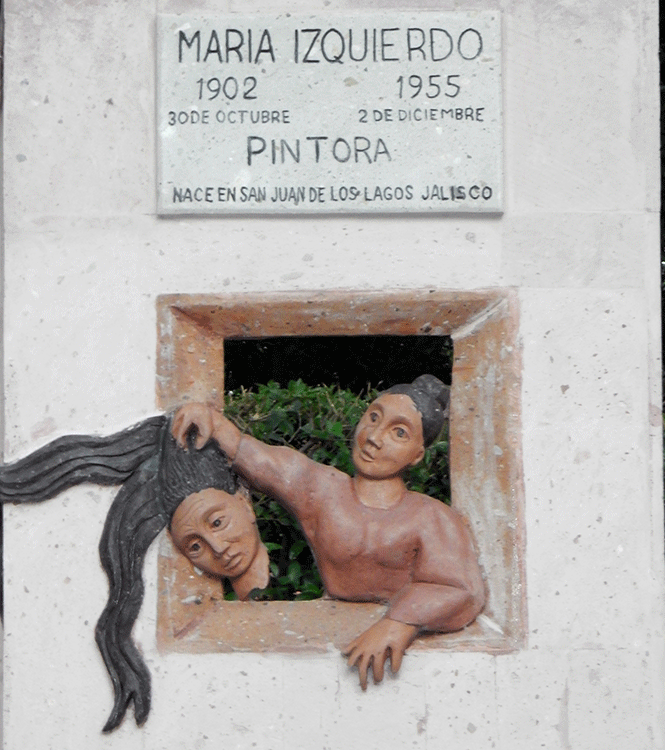
In 1945, at the height of her career, the government commissioned (Maria) Izquierdo to do a mural for a building in Mexico City. (Diego) Rivera and (David Alfaro) Siqueiros, two of Mexico’s great muralist painters, blocked her from getting the job. When she dared to denounce them in public, she received little help and a lot of strong criticism….
Izquierdo began to experience nightmares that left her sleepless. One day, she arose and drew what she remembered… a clear vision of herself, in a window of metaphysical dimension, holding her own decapitated head as her body, still walking, becomes lost in the distance of steps leading to a void. That year, 1947, she painted “Sueños y Pensamento,” a premonitory painting that heralded great pain for her future. It was the last of her great works.
“Maria Izquierdo – Monumento Artistico de la Nacion,” Rita Pomade, Mexconnect, 2007
We journeyed to Panteon de Dolores, home to a population of a million old souls qualifying it as Mexico’s largest cemetery, on All Saints Day. We encountered less than a handful of families celebrating Day of the Dead traditions graveside with their ancestors. Perhaps more ventured out on the following day, All Souls Day?
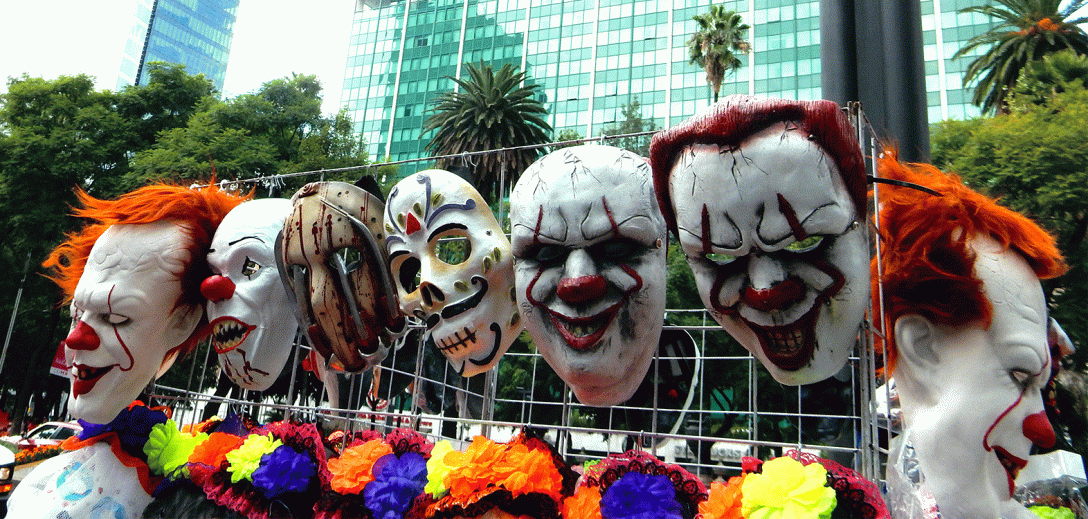
While many graves were colored with an abundance of marigolds, the majority appeared untended by those left behind on earth. Perhaps the more antiquated term of Hallowmas is a more fitting name to apply to the day in this neighborhood occupying close to 600 acres between two main sections of the sprawling Chapultepec Park. Numerous graves were adorned with a jumbled combination of ancient Day of the Dead traditions with more recently imported Halloween decor – spiders, plastic pumpkins, orange and black plastic festoons and fake spider webs.
There was an ongoing mixture of entertainment, ranging from an annoying clownish play to a talented female vocalist while we were there, staged in the plaza of the Rotunda de las Personas Illustres. At dusk, children appeared in Halloween or Catrina costumes carrying plastic pumpkin baskets for trick-or-treating.


While the dearth of ancient practices was disappointing, change happens. And I need no flowers or incense to encourage me to wander through a cemetery. So many stories shout at you from all directions.
Despite the rejection of her mural, Maria Izquierdo gained admittance to the portion of the cemetery dedicated to the illustrious of Mexico. Perhaps her fellow muralists, Rivera and Siqueiros, forgave her for her earlier criticisms of muralists including political messages in their works before they joined her there. The excerpt above is a link worth tapping to begin to learn about her life. I found myself wandering on the internet to discover more about the fascinating artist who was the first Mexican woman to mount a major solo exhibition in the United States.
But there are others. Composer Agustin Lara, who left the women swooning with his “Senora Tentacion” in 1956.
Rosario Castellanos, who wrote because: “Writing has been a way of explaining to myself the things I do not understand.” And redefined laughter: “We have to laugh. Because laughter, we already know, is the first evidence of freedom.”
Actress Virginia Fabregas.
In addition to those celebrated within the inner circle of the cemetery, there are close to a million others with stories worth telling. Hopefully, the trials, tribulations and joys they experienced are preserved within their families’ oral histories, repeated over and over at holiday celebrations lest the tales be lost.
And then, there are the eerily spooky graves. The angel guarding the rusty doors of a crypt, unhinged as though indicating the residents fled the confined space long ago. The coffin rusting above ground. Occupied, empty or home to a vampire planning to emerge with the rise of the next full moon?
A belated happy Hallowmas from Mexico City.


 Postcards from Barton Springs