Postcard from Oaxaca, Mexico: Richness of contemporary art scene evident at MUPO

Above: Detail of “Aborregados 6” by Soledad Velasco

The works with acrylic and India ink are a mixture that balances the safe and the unsure, the spontaneity and the calculated. While acrylic is more stable and gives solidity to the work, the pen and water give that feeling of chance, of an accident that must be controlled…. The immediacy and freshness, the lack of control when one decides to drain the water and the necessary control that ends up being exercised, all of this is a metaphor for what each day has in store for us. And in my case, a reminder that nothing is entirely predictable or certain.”

Soledad Velasco

Originally hailing from Oaxaca, artist Soledad Velasco spent 25 years working in Spain before returning home in 2019. Earlier this year, we saw the fruit of her time spent since then in a one-person show, “A Eva,” at Museo de los Pintores Oaxaquenos, or MUPO.

Continue reading “Postcard from Oaxaca, Mexico: Richness of contemporary art scene evident at MUPO”
Postcard from Morelia, Mexico: Morelos’ call for justice echoes in this hall

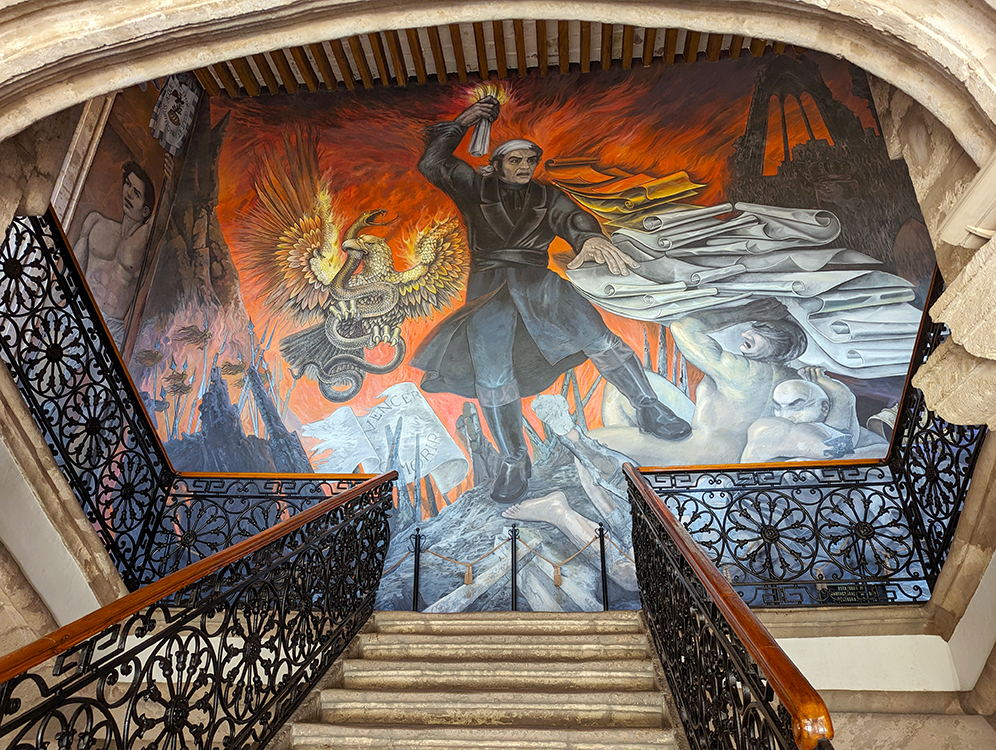
Above: Portion of “Morelos y Justicia” mural, Agustin Cardenas Castro, El Antiguo Palacio de Justicia

Inflamed by the fervor of revolt, Jose Maria Morelos dominates the stairwell of the former governmental headquarters for the Spanish city originally known as Vallodolid on the central plaza of his namesake city. In 1812, the building was repurposed to serve as a mint producing copper coins and postage stamps.

A Belgium engineer hired in 1884 to convert the structure into Michoacan’s supreme court added French architectural detailing to the façade and interior. Particularly distinctive are the pinjante arches, floating double arches with no central support columns.

Continue reading “Postcard from Morelia, Mexico: Morelos’ call for justice echoes in this hall”

Postcard from Marfil, Guanajuato, Mexico: Artists gave new life to ancient hacienda

Silver from el Minero de Santiago Marfil afforded one of the Spanish elite settling in Mexico to purchase land above the Rio Guanajuato and oriented toward a church for a luxurious hacienda in the late 1700s.

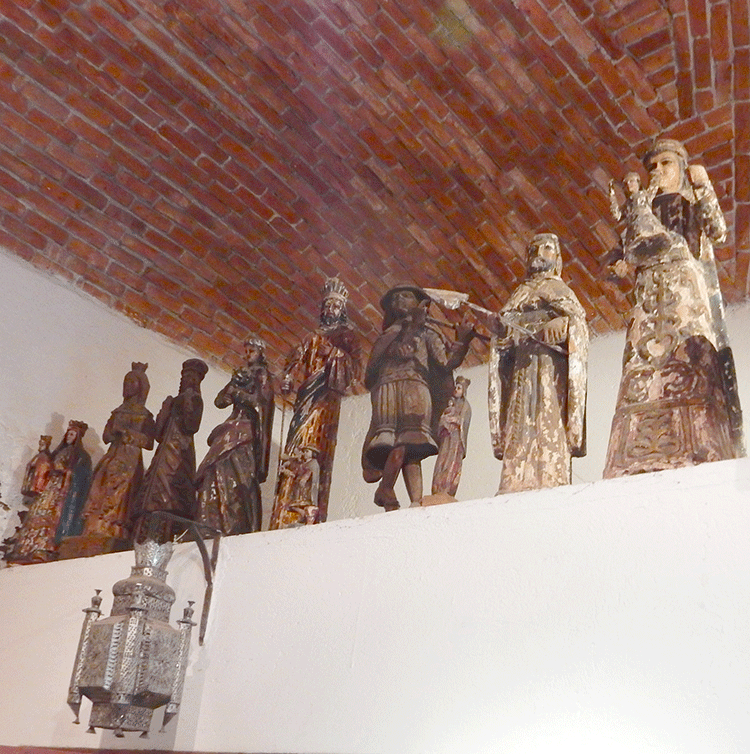
Centuries later in the 1960s when Canadian artist Gene Byron (1910-1987) and her husband Virgil Fernandez del Real purchased the ex-hacienda Santa Anna, Marfil was somewhat of a ghost town. The couple transformed the ancient buildings and grounds into a showcase for their collections of Colonial art and the results of their own artistic endeavors. In addition to her painting, Byron learned to craft handsome punched tin and copper pieces that are found throughout the house museum her husband opened to the public after her death.

The museum often hosts live classical or jazz concerts on Sundays in an intimate setting. During the week, wandering through the house with a docent often is a private tour.

There is a restaurant on site, but we visited on a Monday when it was closed. Although the road through no longer-sleepy Marfil has traffic speeding along, we walked along the narrow sidewalk to ascend to the colorful church perched above and then passed by the ancient statue-topped dam across the river on our way to score an incredible Italian feast at Piccato di Gola, fifteen minutes away at the other end of town.