
The scent of crushed pine needles. Crosses created from flowers. Fruit. Bowls of pozole. Marigolds. Coca-Cola.
Wait, Coca-Cola? More in a later post.
But, everything here is being prepped to make the departed feel welcome to return for a visit.

Gayle Brennan Spencer – sending random thoughts to and from South Austin
The scent of crushed pine needles. Crosses created from flowers. Fruit. Bowls of pozole. Marigolds. Coca-Cola.
Wait, Coca-Cola? More in a later post.
But, everything here is being prepped to make the departed feel welcome to return for a visit.

Hallowmas, or All Saints Day, is such a convenient make-up day for Catholics. There are so many saints, some have been forgotten. November 1 represents a time to remember all of them in one powerful group prayer.
The following day, All Souls Day, is ideal for praying for all the departed, particularly those who escaped hell but were not quite good enough to have Saint Peter throw out the welcome mat – those poor souls stuck in limbo or purgatory.
For many of the indigenous people of Mexico, Catholicism is but a recent thin veneer topping centuries of ancient Mayan beliefs. We are in the heart of that land. November 1 is celebrated as Dia de los Inocentes, a time to communicate with all the small children your family might have lost. November 2 is Dia de los Muertos, or Day of the Dead.
While a small number of Americans hold séances to try to entice loved ones back for a visit, most Americans shrink away from the thought of inviting ghosts back to be part of our lives. But here, families devote much time and energy to cleaning their ancestors’ graves in preparation for decorating them with items to entice the departed back to earth.
This past Sunday, we viewed some of these efforts outside a church that burned long ago. A band played spirited music outside the front of the ruins to entertain those hard at work and those lying underground.
Please excuse the quality of these photographs, but San Juan Chamula operates under its own set of laws. And one of these is you are not allowed to take photographs in its churches or close-ups of any people without permission, rarely extended by the city’s elders (more later). Violators will have cameras confiscated, or worse.
Throughout San Juan’s valley, patches of marigolds are squeezed tightly amongst rows of corn. The marigolds will be harvested for the graves to help guide the dead to earth.
The sincerity of all the preparations is critical because one would not want the dead to feel inadequately welcomed, particularly because they can impact one’s prosperity throughout the coming year.
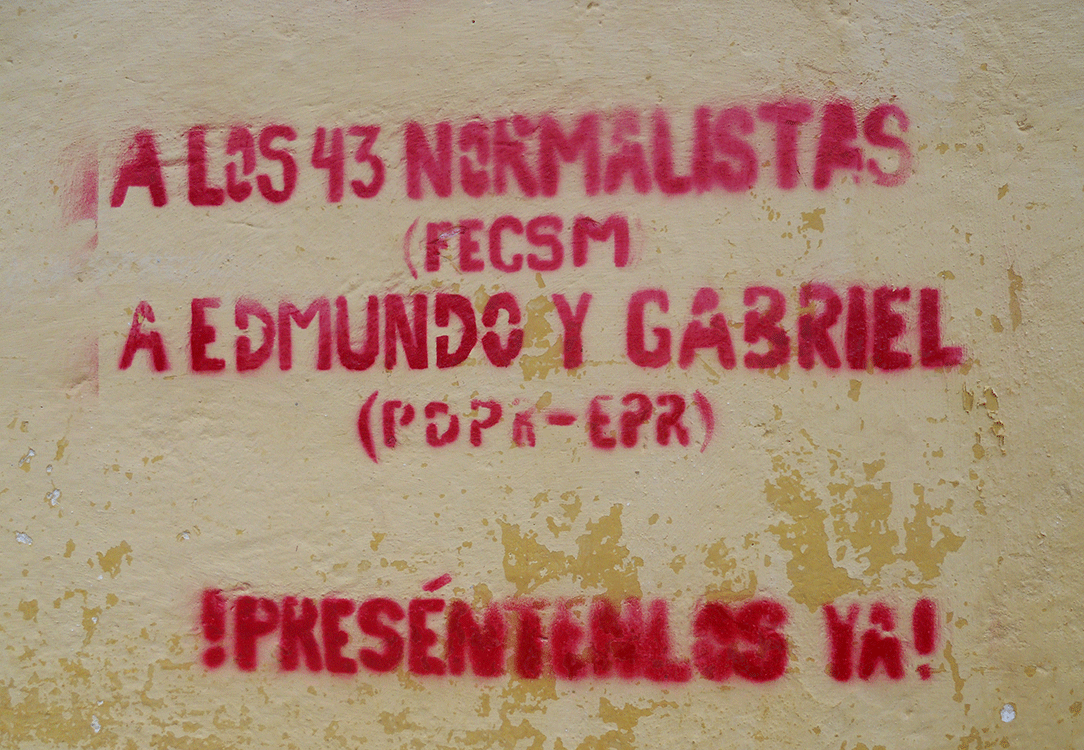
Forty-three. The number calls out from walls throughout downtown San Cristobal de las Casas.
And copies of their photographs leave their faces staring at you blankly as you wander near the zocolo at the heart of the city.
The desaparecidos, the missing students, may be from the State of Guerrero, but the sentiments of many of the young people studying to be teachers in this city appear to be with them.
City hall is heavily patrolled by well-armed soldiers during the day, but they check out for the night. On October 24, while the only guards were the janitors armed with mops, protesters took over city hall for the day. They also assumed control of the toll booths on the highway linking San Cristobal de las Casas and the state capital, Tuxtla Gutierrez.
Yesterday, the normalistas were back again, occupying city hall to call attention to the plight of their compadres.
The sit-in is peaceful. The protesters are unarmed. The blockade of the government offices is enforced by only a single string encircling the building.
Although the students could easily be overcome by force, the police and soldiers remain a distance away. There is no apparent desire to spark any confrontations. The students were allowed to express their concerns, with the everyday rhythms of the city expected to return today.
 Postcards from Barton Springs