‘1,2,3. What do you see?’ Too many toucans to count.

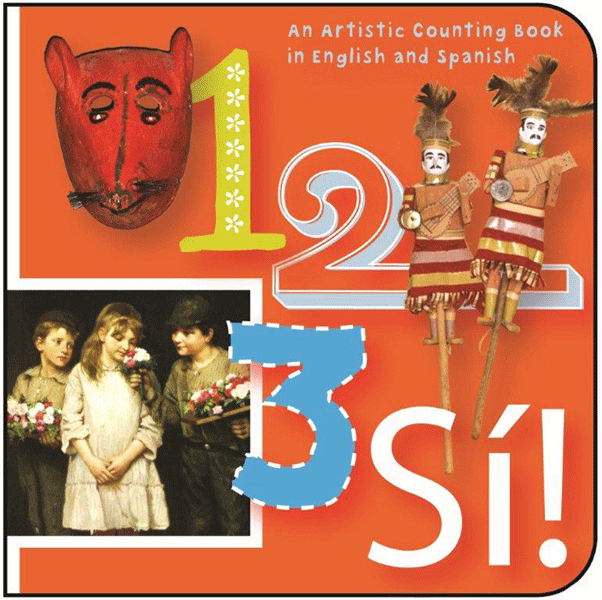
And the hardest part of counting must have been choosing what colorful images to include in 1, 2, 3, Sí! A Numbers Book in English and Spanish. The partners creating this new bilingual board book had to narrow down what to count from the immense holdings of the San Antonio Museum of Art.

Can’t imagine how they managed. And never have Pre-Columbian earthenware babies looked so appealing and downright ticklish, or a combination of images of eight animals from artisans of different centuries from five different countries seemed so logical.

With the assistance of many donors, the San Antonio Public Library Foundation provides the more than 25,000 babies born in Bexar County each year with their first books. Shortly after the newborns arrive, the books are delivered in the hospital to their parents in a Born To Read tote bag that also contains a Library card application and a map of branch locations throughout San Antonio.

Fluffy rabbit from "Pat the Bunny"

A baby’s first books are so important in starting a child off in the direction of a life-long love of learning. If a book is fun and appealing, a baby will want it read again and again. And again and again.

Our daughter wore out her first copy of Dorothy Kunhardt’s Pat the Bunny, but could not bear to be parted from it. We were forced to buy a second copy and perform countless more readings. Alas though, soon “Fuzzy Wuzzy had no hair.” We finally had to alter the words for the second over-petted rabbit to “Love the poor bald bunny,” foreshadowing her impending graduation to The Velveteen Rabbit.

The Library Foundation changes the books in the Born To Read bags every other year so families with more than one child receive different books. The idea to create a book based on the San Antonio Museum of Art’s collection was inspired by My First ABC.  Each letter in this bright board book is illustrated by a work of art drawn from the collection of the Metropolitan Museum of Art, from Paul Cezanne’s “Apples” to an X-shaped painting by Frank Stella.

The expertise of Trinity University Press was tapped to publish 1, 2, 3, Sí! The bright and colorful look of the book was designed by Madeleine Budnick, with photography by Peggy Tenison.

While promoting counting, bilingual literacy and art, 1, 2, 3, Sí! contains smaller-font hints for parents, grandparents, sibling and sitters to use the images for additional interaction. For example, the pages containing ten masks prompts “Which mask would you like to try on?,” with options including a rabbit mask from Mexico, a dog mask from Ecuador and a spirit figure from Papua New Guinea. A mesmerizing pair of eyes from an Egyptian coffin provides an opportunity for playing peek-a-boo.

Other suggestions for stimulating babies’ growing minds will be found in a companion activity booklet being designed by César Proa of Proa Design. Trinity University Press is creating a website – www.123-si.com – with ten related coloring and activity pages for teachers or parents to download and print.

Mayor Julián Castro officially will unveil all of these during a Family Launch on Saturday, September 10, at the Museum of Art. Families need only show their library cards to gain free admission to the museum during the event.

While the publication of 1, 2, 3, Sí! is exciting, there is more to come. The partners promise board books focusing on colors, shapes and animals will soon follow.

For those of us with no babies being born in San Antonio hospitals, 1, 2, 3, Sí! will retail for $7.95. 

Born to Read from SAPLF on Vimeo.

Blog followers fail to encourage me to curb my meanderings…

My blogs tend to wander all over the map as far as subject matter, but I was curious as to whether statistics from the past 12 months* would help me rein in those meanderings. They don’t.

By far, the most-read post is about Cheez Doodle sculpture at the McNay. While Alamobsessive posts proved popular during this turbulent year for the Daughters of the Republic of Texas, readership follows less sensational subjects as well.

  1. Cheez Doodles as Art, posted on January 8, 2011
  2. Ban the Banner, posted on August 8, 2010
  3. Alamollywood Part I: Are the Daughters Extremely Savvy or Starstruck?, posted on January 2, 2011
  4. Alamoment: How the Daughters Felt on Receiving Audit Request, posted on July 1, 2010
  5. Best Restaurant in Valladolid, Plus Warning, posted on March 17, 2010
  6. “Nuit of the Living Dead,” posted on October 30, 2010
  7. Wayfinding and New Accessibility Enhance River Walk Experience, posted on August 19, 2010
  8. Seesawing Signage Issues: Take three baby steps forward and two giant steps back., posted on September 4, 2010
  9. Please put this song on Tony’s pony, and make it ride away, posted on July 25, 2010
  10. Preserving the Art of ‘Papel Picado,’ posted on April 30, 2010
  11. Blogger’s Post Fans Memories of The Flame Room, posted on September 16, 2010
  12. Downtowners Dutifully Delve into Duck Doody, posted on March 21, 2010

Thanks for following, and love the new friends I’ve met via blogging. I’ll check back on the statistics in six months to see if you’re hinting I chart a more disciplined course.

* Several of these posts date from more than a year ago, but they are still drawing enough hits to keep them on this year’s list.


Susan Toomey Frost stimulates a second revival of San Antonio’s traditional tilework

“Benign Obsession” was the moniker she assumed on eBay, but, fortunately for San Antonio, Susan Toomey Frost’s obsession with the products of San Jose Tile Workshops proved anything but benign.

I first “met” “Benign Obsession” online, back when eBay was more fun because you could see the id of those you were bidding against, begin to understand their patterns and learn from an expert willing to warn you of forgeries lurking out there. Susan, in fact, became the leading expert on San Jose Tile Workshops; she literally wrote the book about them. The stunningly beautiful publication, Colors on Clay, was published by Trinity Press in 2009.

I was excitedly telling Sally Buchanan, then president of the San Antonio River Foundation, that I finally succeeded in purchasing a San Jose plate on eBay when she casually mentioned her friend, Susan, was looking for a home for an entire tile mural. I was thrilled to be near one plate, but an entire mural…. With miles of extended riverside trails in the planning stage, surely we could find a home for a Work Projects Administration ((WPA) era mural.

And Susan said, yes, of course, she would donate it to the River Foundation. 

This slideshow requires JavaScript.

Privately commissioned by Mayor Maury Maverick, the 188-tile mural had been rescued by Susan from a home on Huebner Road that was slated for demolition. She flew in a tile preservationist from California to gently pry the mural from concrete and carefully stored the tiles for close to a decade.

“What I do,” Susan explained to me the other day, “is try to save their lives and get them in public view in a safe place.”

Architects from Ford, Powell & Carson came up with the ideal location within the project, directly below El Tropicano Hotel on the river, the point where the original Robert H.H. Hugman designed River Walk began and the new Museum Reach now extends northward. This also is directly below the spot where the mural was born – the Mexican Arts and Crafts shop operated in the old Nat Lewis Barn by Ethel Wilson Harris (1893-1884).

In Colors on Clay, Susan wrote that Harris became the technical supervisor of the Arts and Crafts Division of WPA in San Antonio in 1939. Sixty workers joined her existing crew of craftsmen in the workshop on St. Mary’s Street.

While I had long admired the two existing murals on the river resulting from the WPA program – the “Twin Cypress” mural on the stairway by the flood control gate at the northern end of downtown river bend and “Old Mill Crossing” now at the river level of Hotel Contessa by the Navarro Street Bridge – I had no idea of the quantity and diversification of the products resulting from the WPA program until reading Colors on Clay. In addition to the four spectacular 60-square-foot works – depicting a century of sports in San Antonio from Native American archers on Military Plaza in 1840 to high school football in 1940 – at the entrance to Alamo Stadium, here are other contributions Susan described:

Six weeks after Harris’s appointment, WPA workers were building a kiln to fire 500 sets of dishes for distribution to needy families….

Harris also supervised the wrought iron shop that forged lanterns, railings, table frames and other decorative and useful objects, including window grilles for the Spanish Governor’s Palace, a fountain in the form of lilies of the valley for the San José Burial Park, a wrought iron gate and window frames for the San Pedro Park bandstand, barbecue pits for Olmos Park, and fifty artistic foot scrapers for schools and city parks….

Because federal funding supported the program, charitable and public institutions in and around San Antonio received the products free of charge. City parks and golf courses, for example, received tile drinking fountains and 1,000 concrete and wooden benches carved with a Lone Star….

Susan’s search-rescue-and-return efforts have taken her on virtual and actual adventures throughout the country as she finds new homes in San Antonio and nearby for the tiles made here long ago. Her obsession with the project is only matched by her generosity: Texas State Centennial tables now live at the Witte Museum and the Wittliff Collection at Texas State University; a “Las Sombras” mural graces the cafeteria at St. Mark’s Episcopal Church; and soon works will be installed on the river behind the Witte Museum, at the Ceramics Studio of the Southwest School of Art, at the new theater at SAY Si and at the restored Women’s Pavilion in HemisFair Park.

And there is another mural, this one recovered from Indiana, that Susan has pledged to the Mission Reach of the San Antonio River Improvements Project. It, too, is returning to just below its birthplace. During her lifetime, Ethel Wilson Harris operated San José Potteries next to Mission San José and Mission Crafts within the mission compound itself. The Mexican village scene will be installed at the portal reconnecting the historical ties of Mission San José to the river.

In 1943, the Texas Legislature recognized Ethel Wilson Harris for her role in “the revival and perpetuation of Mexican arts and crafts,” skills Spanish friars taught Native Americans long ago on mission grounds, skills almost lost as Americans rushed pell-mell into an age where machines mass-produced what once had been crafted carefully by hand.

This traditional art form from San Antonio’s past is now entering its second revival due to the efforts of Susan Toomey Frost. Her obsession is bringing the tiles home to roost before they were lost or all ended up hidden away from public view in the homes of wealthy Californians.