Stacy Levy: Interpreting the Connections of Nature and the Built Environment through Art

Often people think that nature ends where the city begins. But natural processes are always occurring in the city. I like to explore the idea of nature in the city and make it visible to people.

Stacy Levy, from her website
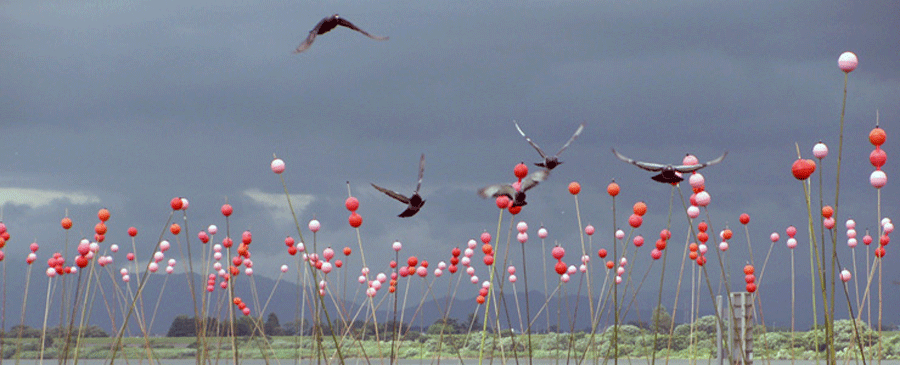
For the 2009 Water and Land Festival in Niigata, Japan, Stacy Levy "planted" 600 18-foot-tall bamboo stems, "like tall grasses moving to the choreography of the wind."

As the Mission Reach of the San Antonio River Improvements Project continues to stretch southward toward Mission Espada, the fruit of the fundraising efforts of the San Antonio River Foundation emerges as public art enhancing the linear park skirting the river’s banks. The next phase opens to the public on Saturday, June 25, and will feature a “portal” strengthening the historical connection of Mission Concepcion to the river.

Although based in Pennsylvania, Stacy Levy is an environmental artist of international standing. Recent commissions include “Tide Poles” on the waterfront in Yonkers, New York; “River of Shade” in Harmon Library Park in Phoenix, Arizona; and “Tide Flowers” in Hudson River Park in New York. She taps talents gleaned from an unusually rich interdisciplinary background – studies at The Architectural Association in London; a B.A. in sculpture with a minor in forestry from Yale University; additional studies at Skowhegan School of Painting and Sculpture; and a MFA in sculpture from the Tyler School of Art at Temple University – for her work.

Stacy shared a flowing description of her impression of the San Antonio River:

The San Antonio River flows through the city, its liquid presence flowing past the hardscape of the urban environment. This wonderful contrast of liquid nature and solid infrastructure is intriguing to me.  Sometimes water works slowly: sometimes languidly carving its path grain by grain, sometimes with the terrible scouring speed of a flood. But whatever the flow of the river, the water is always moving in a particular pattern of fluid dynamics. This pattern is beautiful but rarely perceivable to the eye. I wanted to capture this aspect of the flowing river and to show people another world of water: the pattern of fluid motion.

Her installation reflects not only the water and natural environment but also the built environment nearby, that of the more than 250-year-old Mission Nuestra Señora de la Purisima Concepción de Acuña. Stacy wrote:

…here, the water is evoked by sloping stone walls, so reminiscent of the architecture of the Mission Concepcion. This place of stone and water is where the mission and the river meet in an artful form, borrowing patterns and materials from each of these icons.  The stone seating walls curve and undulate like the major hydrological forces, creating a pattern of vortices made from stone which sweep the park user in. I tried to make this solid and dry environment feel like the swirling movement of river water.  And the walls undulate and slope like the Mission’s walls, are rough and cool to the touch in the shade of the trees planted in the terrace.

Portal at Mission Concepcion as envisioned by artist Stacy Levy

The gracefully curved walls and walkways will be completed in time for the June 25th celebration, but they are only the first phase of her contributions to the Mission Reach. While the final design for the next portion have yet to be approved, Stacy envisions art evocative of the fluid patterns of the river meshed with the original floral patterns found at Mission Concepcion.

More wonderful reasons to keep walking the river (refer to older posts such as this and this). 

Update on June 24, 2011: Preview of the opening of the next segment of the Mission Reach from the Express-News

Update on June 26, 2011: Express-News reports about Anne Wallace’s footbridge and more art to come….

River Improvements Continue Snaking Their Way South

A year ago, the stretch of river off of Mitchell by Boneshakers and the perch where G&G Bistro sometimes parks its food truck resembled a lunar landscape. Today, its stunning wildflowers would inspire an Onderdonk to pick up a brush.

Took a tour, a bit unofficial, of the next phase of the Mission Reach, scheduled to open in mid-June. With no landscaping yet, it appears stark. But the scale is so much greater than one is used to on the more urbanized portions of Paseo del Rio; the sweeping vistas are breathtaking even now.

The San Antonio River Authority is applying lessons learned from the earlier phases. Temporary drip irrigation hoses are installed, which should jumpstart seedlings quickly.

Like me, the water birds are impressed by the dramatic environmental improvements. Impatient, they already have staked out their islands and fishing turf well ahead of the restoration of the riparian plants on the banks.

Update posted on June 27, 2012: Donald Ewers shares some great photos of the happy inhabitants of the Mission Reach a year later….

As if they already don’t do enough: ‘Conserve Today and Secure for Tomorrow’

Didn’t need to get very far into a facebook “conversation” for Anne Thatcher Parrish to comprehend that I had flunked waterbird-watching 101, or actually never emerged from the kindergarten stage. Although she volunteers weekly to conduct nature tours for children at Mitchell Lake, Anne agreed to try to educate me in the environment where I walk in the mornings – along Eagleland and the Mission Reach of the San Antonio River.

First up, of course, were mallards. Then there was a double-crested cormorant, a broody-looking black one with a hooked bill who can hold his breath while fishing under water for an incredibly long time. A tall white egret searched for crawfish, while a great blue heron flew overhead.

Then we came upon a crowd that greatly multiplied the San Antonio River Authority’s normal work crew on the river’s banks. They appeared to be volunteers harvesting large quantities of invasive plant material near the water’s edge.

Then my favorite – the yellow-crowned night heron. Next a mature little blue heron (little actually being part of its name), and, just to try to confuse me, an immature one that had not turned blue-gray yet but was white.

More volunteers in a canoe fetching trash collected from a man in waders. A huge sheet of heavy black sheeting they pulled from the river was crumpled up next to discarded pairs of crawfish claws left on the egrets’ favorite breakfast table near the train tracks.

Can crawdads not see yellow? It seems as though the schoolbus-yellow feet of the wading snowy egrets would be hard to miss underwater. A sandpiper scurried by.

At a doughnut refueling station near Roosevelt Park, Anne asked the volunteers who they were. A woman answered enthusiastically they were from all branches of the Armed Forces in San Antonio, and this was how they were celebrating Earth Day. She said proudly:

This is our community, and we want to give back to it.

Of course, Earth Day is not actually until tomorrow, but the Air Force is proclaiming “Every day is Earth Day,” with this year’s theme as “Conserve today and secure for tomorrow.” The volunteers come from the Air Force Center for Engineering and the Environment, the Air Force Civil Engineer Support Agency, the Air Force Real Property and  502nd Air Base Wing.  They started celebrating by performing hard manual labor at San Pedro Park (photo) on April 1 and Memorial Park on April 14.

By the crayola footbridge, we encountered those with the roughest assignment wading and raking out large slimy swaths of oozing blooming green algae so thick a family of six little ducklings was easily walking across it.

Bob Moore, director of the Air Force Real Property Agency in San Antonio, told Texas Public Radio’s Eileen Pace it was a rewarding experience:

We were scraping some algae off, and a 12-inch long bass jumped right out of the water because we had scraped the algae underneath it. Ducks were coming in right behind us in the clean water and reclaiming the area we had just cleaned out.

On the way back, spied a pair of my second-favorite birds, not because of their shocking flourescent pink-orange bills and webbed feet but for their name. For some reason, it just makes me smile: black-bellied whistling ducks. Anne said that now I can even graduate to Mitchell Lake.

I don’t think I’d be misspeaking to extend thanks to all the volunteers from the Armed Forces on behalf of the birds. The egrets and herons probably all settled into their nests in the trees off of Alamo Street last night with such strong feelings of security they decided to expand their families. Their home, this river, keeps getting better and better.

Update on April 22, 2011: And the wildflowers are beautiful!