
Kathleen Carter. Karen Thompson. You go, girls! Speak your mind.
According to Ken Herman in the Austin Statesman, Texas Land Commissioner Jerry Patterson is attempting to force these leaders of the Daughters of the Republic of Texas to bite their tongues:
…Patterson banned Daughters of the Republic of Texas officials from talking to reporters about the Alamo without his agency’s approval. “Information released without prior knowledge and express approval of the GLO may be grounds for immediate contract termination,” says his new rule.
Now those are fighting words.
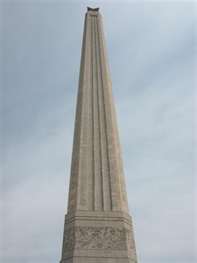 Commissioner Patterson, you are new at your job. Yes, I know you have been Land Commissioner for a decade, but you are newly arrived at the Alamo. Yes, I know the Sons of the Republic of Texas deemed you a Knight of San Jacinto and you represented the county that includes the soaring monument on the battleground. But having that giant erection in your backyard must have gone to your head.
The Alamo is different. As San Antonians first and Texans second, we regard fighting about the Alamo as a sacred right. We have been fighting publicly about it since 1836, and no one in Austin can quash those afflicted with severe cases of Alamobsession.
Yes, running a dictatorship is easier than a democracy, but the Daughters themselves already tried that approach. Some of the very people Commissioner Patterson wants to silence attempted to gag dissension among their own siblings. Without success. Fortunately for Texas. If Daughters were not so persistently outspoken, the General Land Office would not be in charge of the Alamo today.
Aside from supporting their right to free speech, my agreement with the Daughters probably pretty much stops there. Although, I never thought the Daughters would call trump with the double-edged Native American card.

Again, from Herman’s column in the Statesman:
…Daughters’ President General Karen R. Thompson said her organization “strongly” objects to the change. “The Alamo grounds are considered sacred, not only because 189 men died in battle on March 6, 1836, but because the remains of Native Americans are buried and entombed in the complex property,” she said in a statement.
The Daughters and the descendants of the original Native Americans whose labors contributed to the ancient mission’s walls are rarely on the same page. But adversity calls for uniting all underdogs.
And unite against what common enemy?, you might ask if you make it this far into this post.
“Hooch,” as Carter terms it. If you somehow missed this story affecting the lives of all Texans, catch up by reading Scott Huddleston’s “Hold the ‘Hooch’” in the San Antonio Express-News. The Land Commissioner has proposed alcohol could be served to those renting out Alamo Hall, not the Alamo itself, for special events.
Yes, the painful specter of prohibition raises its head once again. The leadership of the Daughters evidently thinks nothing stronger than apple cider should be raised in toasts anywhere near the Alamo.
Apple cider? What would Davey say?
While I’m willing to accept William Barrett Travis might have been a teetotaler, what about the rest of the guys?
Taking a lead of freedom of revision of history from the Texas State Board of Education and accepting Travis did indeed draw a line in the sand…. If Travis asked how many men wanted to be forced to convert to Catholicism, many men at the Alamo would have leapt to join him for the promise of freedom of religion.
If Travis asked who wants to continue to ride deep into the heart of Coahuila every time you want to conduct official business, not many at the Alamo would have stayed on the side of Mexico. That was a major inconvenience.
But, on the other hand, if Travis had drawn a line and said you can drink alcohol on the Mexican side but my side is dry? Travis might have found himself pretty lonely.
Free speech I’m all for preserving, so the Daughters get my backing on that issue. But keeping Alamo Hall, which was off the battle site, dry? Not worth fighting for.
This is not an “Alamoment.” Seems as though both the Daughters and the Commissioner should pick their battles more carefully. They should be forging a strong partnership, not tearing it asunder.
What would Davey say? Remaining in the revisionist vein of amateur historians, I think he gladly would raise a glass of something hard:
Salud, amor, pesetas y tiempo para disfrutarlos.
 Postcards from Barton Springs