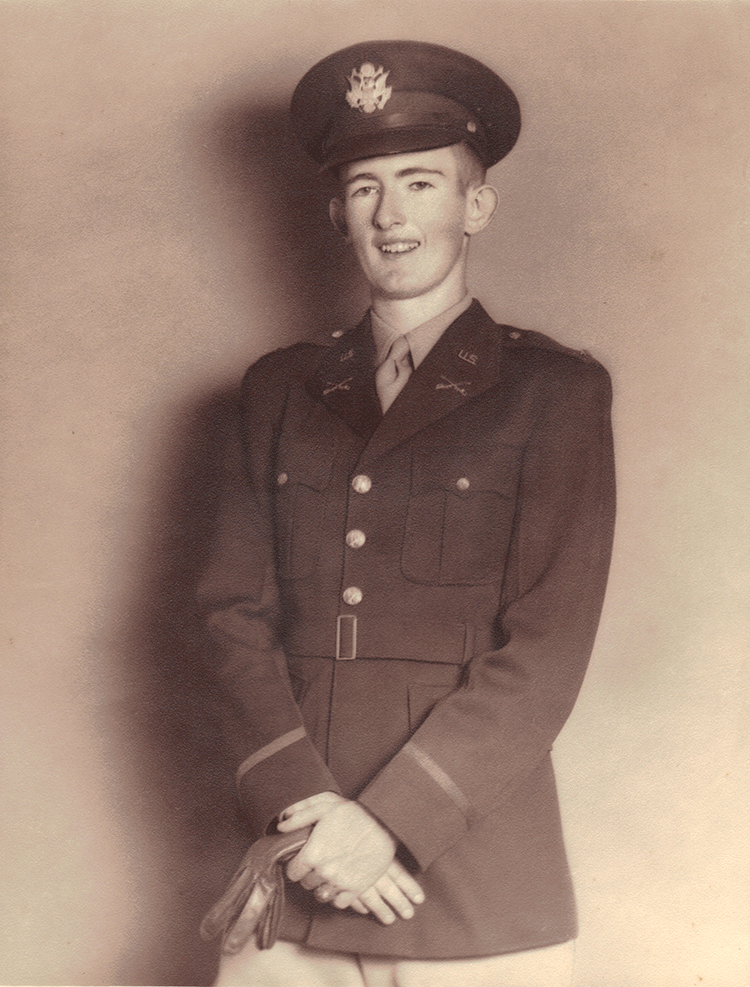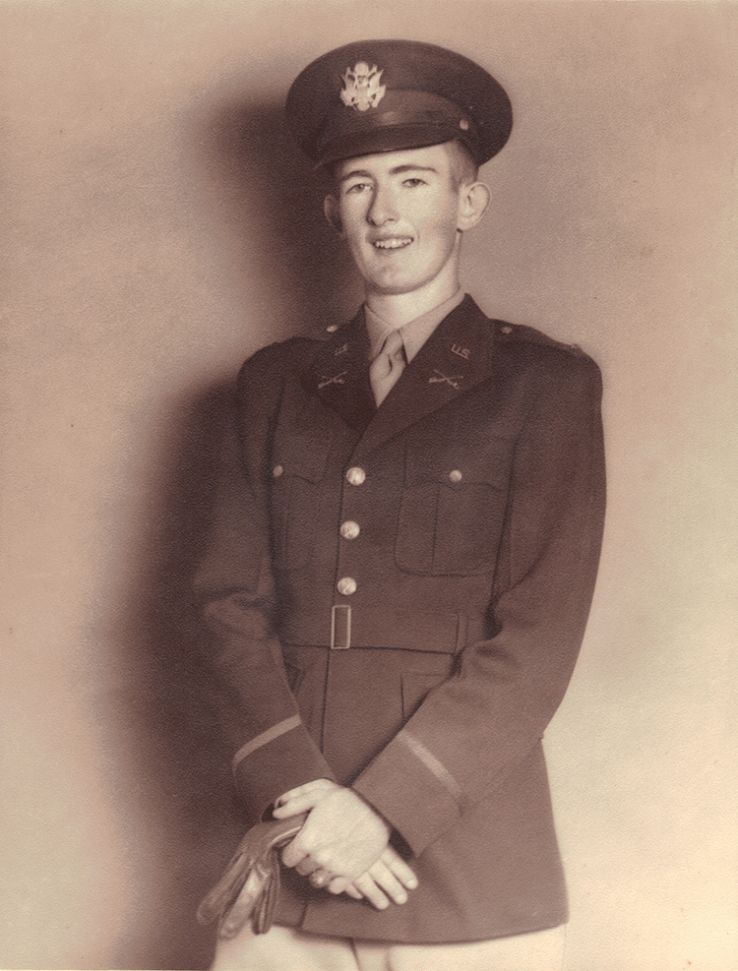
George Hutchings Spencer died on June 29, 2013, at the age of 89. George was born in 1923 in Kendall County in the house he and his sister still own. His parents were Flora Houston Johns (1894-1962) and Radcliffe Spencer (1881-1965).
After graduating from Boerne High School, he entered Texas A&M University. Following his junior year, he voluntarily enlisted in the United States Army. Despite a passion to serve in the Horse Cavalry, he received his commission in the Armor branch. He then volunteered for Jump School and, following completion, was assigned to the 101st Airborne Division. He was honorably discharged as a 1st Lieutenant in 1945.
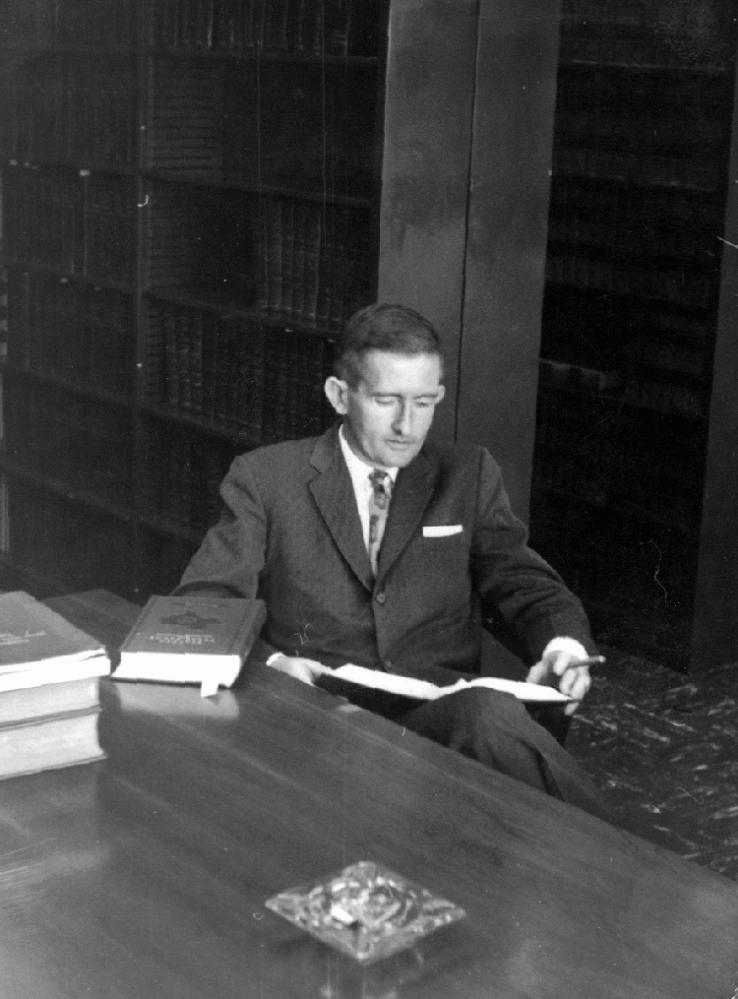
Like many others in the Class of 1944 at A&M, he never completed his senior year. Instead, he entered Law School at the University of Texas. After graduating in 1948, he joined the law firm of Davis, Clemens, Knight & Weiss in downtown San Antonio. He became a partner in 1957, and the name of the firm evolved to Clemens, Knight, Weiss & Spencer. In 1990, the firm still led by his son, George, became Clemens & Spencer.
A Fellow in the American College of Trial Lawyers, he tried cases to jury verdicts in more than 30 counties throughout the state and argued before multiple state and federal appellate courts. George retired in 1998 after practicing law for 50 years. Among the honors he received were the Texas Center Professionalism Award (2000); the Joe Frazier Brown, Sr., Award of Excellence (2004); and the Ethical Life Award (2009). In 2012, he was recognized as the Outstanding 50 Year Lawyer by the Texas Bar Foundation.
He married Virginia Lamar Hornor (1924-2000) in 1950, and they raised three sons: George Hutchings Spencer, Jr., married to Polly Jackson Spencer; Lamar Radcliffe Spencer, married to Gayle Brennan Spencer; and John Cotton Spencer.
In addition to his children, he is survived by his sister Dorothy Traylor of Boerne and five grandchildren: Caroline Radcliffe Spencer of San Antonio; George Hutchings Spencer, III, of Philadelphia; Virginia Lamar Spencer Summers and her husband John Summers of Dallas; Katherine Conway Spencer and her husband Cameron Ladd of Austin; Warren Jackson Spencer of San Antonio; as well as numerous beloved nieces, nephews, grand nieces and nephews, and cousins.
In lieu of flowers, the family suggests memorial contributions be made to St. Mark’s Episcopal Church, Good Samaritan Community Services or the charity of your choice.
A memorial service for George will be held at 11:30 a.m. on Wednesday, July 3, at St. Mark’s Episcopal Church, the church in which he and Virginia were married, at 315 East Pecan Street.
I wasn’t looking for Maggie this afternoon. But her name called out to me in the middle of a UTSA Libraries list of recorded interviews you can listen to online. I wanted to hear her voice, resurrected from the past.
At first, I was disappointed to find hers was only a transcript from an interview on KLRN. But, as I started reading, I realized it didn’t matter. I could hear her.
Susan Margaret Cousins (1905-1996) had one of the most distinctive voices I’ve ever heard. Maggie lived in New York City during much of her illustrious career including time as editor of Good Housekeeping and McCall’s and at Doubleday Publishing; yet years in the Big Apple failed to tame her Texas accent. In the March 24, 1974, edition of the San Antonio Express-News Mildred Whiteaker wrote, “Authoress Edna Ferber used to visit Maggie to get the flavor of the dialogue for Giant.”
Maggie’s pitch was incredibly low, and the words drawled out gruffly from somewhere deep in her chest. Most sentences ended with her wonderful chuckle rippling through her entire body.
Of course, most of the time I was listening to her it was happy hour. You never wanted to miss it when Maggie was holding court in the huge wooden corner booth where the “River Rats” gathered five days a week shortly after 5 p.m. as diligently as if punching a job-required time clock.
Maggie was a regular as long as she and her cane could propel her slowly huffing and puffing down the River Walk to the Kangaroo Court from her double-apartment in the Clifford Building. As a professional woman, Maggie broke the glass ceiling, inspired others to follow and never stopped writing, but the undated interview on UTSA’s website deals with Maggie in her role as a true urban trailblazer in downtown San Antonio in the 1970s:
I’ve been unusually happy in the city because when I first came I used to just walk up and down the River Walk. Sat down at Kangaroo Court one day and had a drink. Bob (Buchanan), the owner, came out and talked to me and from then on it became my place. I met all the young people that work downtown and the people that have the dreams and hopes and ideas and I was able to be in and listen to all their plans and most of them have come through with a lot of them. The wonderful young people who are downtown.
The booth in the Kangaroo Court was a great incubator and percolator for ways to improve downtown. But Maggie was one of the few “rats” who actually lived right downtown.
Here are a few of the Maggie-isms about dwelling downtown from the interview transcript:
There isn’t any atmosphere in the suburbs. You know, people live in large houses, have great manicured gardens, and they never go outdoors. I never see them using their lawns for any purpose.
I intended to have a car when I first came , and I couldn’t find a place to park. Living alone, you need a place to park and you can’t leave it in front of the building. So, I waited until they built a garage and then I was too old to drive.
Since the big boom in building has come and many of the old buildings have gone; when the new ones are built the rents are too expensive for small-time businesses like typewriter repair. When I moved here that was very important to me. There were three repair shops within walking distance of a block.
Mr. Butt, who lives in King William, has not built a grocery store for us poor people. But I presume when all these big condo projects are inhabited there will have to be a grocery store. I’ll be 95 years old. I’ve faced that.
I’d rather put up with the inconvenience and enjoy the things I enjoy down here. This place is within walking distance of the public library, which is important to me.
I have women friends who haven’t been downtown in ten years, they say proudly. I say, you gotta be crazy.
…I thought if I show people that they can live downtown they’ll get interested in it, but Texas people are very hard to change. But sooner or later, this generation will be interested in it.
If I ever get bored, all I have to do is look out the window….
Your lives are always made up of the past, present and future and without the past you just don’t have very much to look back on. And I think that San Antonio, that’s one of its great charms, the fact that it has some extremely fine 18th century architecture and lots and lots of 19th century architecture which I think gives it a quality that no other city in Texas has.
Imprint of human life on a place makes it more interesting and more attractive.
And Maggie’s imprint was rich and lasting.
I can hear her even now.
Update on June 13, 2013: Maggie’s obituary from the New York Times
I didn’t have any children to play with, but I had Grandpa and Grandma and aunts and people who had time to talk to me. They told me stories. That’s one reason why I became a writer.
After all, you are the Mister’s third great-grandfather and the source of his middle name.
And you’ve been around a long time, a very long time.
Your frame certainly shows it. It appears to have endured a war or two; although I’m not sure wars were what caused its wounds. You are merely an engraving of sorts, but your frame was impressively regal at one time. We’re not sure what time, but I’ve never encountered another frame with such a heavy, brown ceramic interior. When did they make such frames?
Before I removed you from our hall, a temporary relocation of sorts, I thought I should write a few words about you. But all I knew was you were a mayor of New York City, which always impressed me.
In Bayard Tuckerman’s name-dropping family history, A Sketch of the Cotton Smith Family of Sharon, Connecticut, Jacob and his wife sound so perfectly civilized:
They lived first at Albany, where he was Judge of the Supreme Court, and afterwards in New York of which he was three times elected Mayor between 1810 and 1818. The Radcliffs had a country home near Poughkeepsie called Chestnut Hill, and there Juliana continued to have “literary evenings,” which are mentioned in letters of Chancellor Kent, Edward Livingston, Chancellor Livingston and Miss Janet Montgomery as “delightful gatherings where youth and age, fashion and wit, met for pleasure and improvement.”
Your resume looks pretty good. Graduated from Princeton. Sat on the Supreme Court of New York State. You joined with your friend Alexander Hamilton in a partnership founding Jersey City. Was that a good thing? Hamilton never got to see if that was a good idea or not, as he made the fatal mistake of insulting Aaron Burr. I do thank you for having the good sense not to follow suit.
Politics is a messy, incomprehensible thing sometimes. Keep Blagojevich, Senate appointments, and all other recent government scandals in mind as you traipse through the thickets of political absurdity below.
And that’s where Jacob Radcliff and John Ferguson come in. They are by no means exceptional leaders; they were Tammany men at the right time, in an era before absolute corruption pervaded the society’s every activity….
On top of the usual partisan stew of a swiftly growing city, the war of 1812 left party affiliations malleable, with Federalists opposing action (even suggesting secession from the United States!) and staunch Democratic-Republicans generally favoring the conflict. Thus, as you can imagine, it would be difficult to remain balanced in such unstable political waters, even for somebody as savvy and popular a career politician as (DeWitt) Clinton.
In this wily tug-of-war between the Federalists and Tammany candidates, Clinton was again unceremoniously ousted in 1810 and replaced with Jacob Radcliff….
The winds shifted again the next year, and Clinton was placed back in the mayor’s seat in 1811. (Following this so far?)
As war broke out with England in 1812, all political parties and affiliations seemed to disintegrate entirely. As James Renwick says in his biography of Clinton, “On this occasion the old party lines were completely obliterated; no trace of affection for Great Britain remained in any mind, and the very name of federalist only exists to be used as a mode of discrediting a political adversary in the minds of the ignorant.”
As a result, many Federalists jumped ship to join the surging Tammany Democrats. Among their number was former mayor Jacob Radcliff, warmly greeted by Tammany head ‘grand sachem’ John Ferguson.
A perfect storm brewed in 1815 when Tammany for the first time controlled the state senate and enjoyed great gains in local elections. For the first time, Tammany could really do what it wanted. And what it wanted was to get rid of that old stalwart Clinton. Once and for all.
And who better to replace him than the head of Tammany himself, John Ferguson? However, whether by intent or sudden whim, Ferguson stepped down after only three months in office to take on the far-more lucrative job of officer of the Port of New York custom house, according to one source a major center “of federal revenue, political patronage and potential graft.”
And so he was replaced with….Jacob Radcliffagain, now a mayoral appointee representing an entirely different political party from the first time he had the job!…
Meanwhile, Radcliff was caught up in a scandal when, halfway into his term, he was caught distributing a list of potential Tammany replacements for all still-remaining Federalist council members, a politically insensitive move which galvanized the Council and ensured that 1816 would be Radcliff’s last year ever as mayor.
Maybe if you didn’t look quite so pompous. Maybe if it wasn’t quite so obvious that you have been looking down your sharp nose at me all these years. Maybe then I wouldn’t have dug deeper into your resume.
The Bowery Boys website even calls you “politically wishy-washy.” The original flip-flopper.
History is the story of events, with praise or blame.
And, whoa. Speaking of looking down one’s nose.
If that cousin had ever been offered for us to hang in the hall beside you, I certainly would have known better. His reputation preceded him.
This is what he would say about the Fiesta-colored garb I sport on a daily basis:
For an old woman to flant [flaunt] it in a youthful dress, is altogether as prodigious a Disorder as for the Flowers of May to appear among the Snows of December.
He never would have made it out of our closet. I could never have borne his disapproving glare on a daily basis.
Besides, Cotton Mather would have burned me at a stake.
Juliana’s puritanical father, John Cotton Smith (1765-1845), a Yale-educated governor of Connecticut, might not have drowned me but certainly would not have approved either.
But that’s partially his son-in-law’s fault. So eager for votes, Jacob Ratcliff was willing to stoop to courtship of the immigrant population swarming into New York City.
You let those damn Irish Catholics get a foot in the door, and, the next thing you know, only a couple of generations later, one of them marries into your family.
So hard to keep that puritanical bloodline pure.
Note Added June 6, 2013: In 1968, one of the Mister’s first cousins, once removed, purchased and restored John Cotton Smith’s former home in Sharon – Weatherstone.