Once upon a time, northern San Antonio was a land of dairies….

The Trustees of the Max and Minnie Tomerlin Voelcker Fund are hosting a celebration of the publication of The Last Farm Standing on Buttermilk Hill: Voelcker Roots Run Deep in Hardberger Park from 5 to 7 p.m. on Tuesday, November 16, at The Twig Book Shop, 200 East Grayson at Pearl Brewery.  Music Max and Minnie would have loved will be provided by the Lone Star Swingbillies.  During the event, 60 percent of any sales of the book will benefit the Phil Hardberger Park Conservancy.

Char Miller, W.M. Keck Professor of Environmental Analysis at Pomona College of Claremont, California, and author of Deep in the Heart of San Antonio: Land and Life in South Texas, wrote: “Few San Antonians remember Buttermilk Hill, but Gayle Spencer has recovered its significance through an intimate portrait of the dairy-farm families who once inhabited the rolling North Side terrain.  Only the Voelckers held out against encroaching sprawl, and the result is Hardberger Park, a verdant vestige of the city’s bucolic past.”
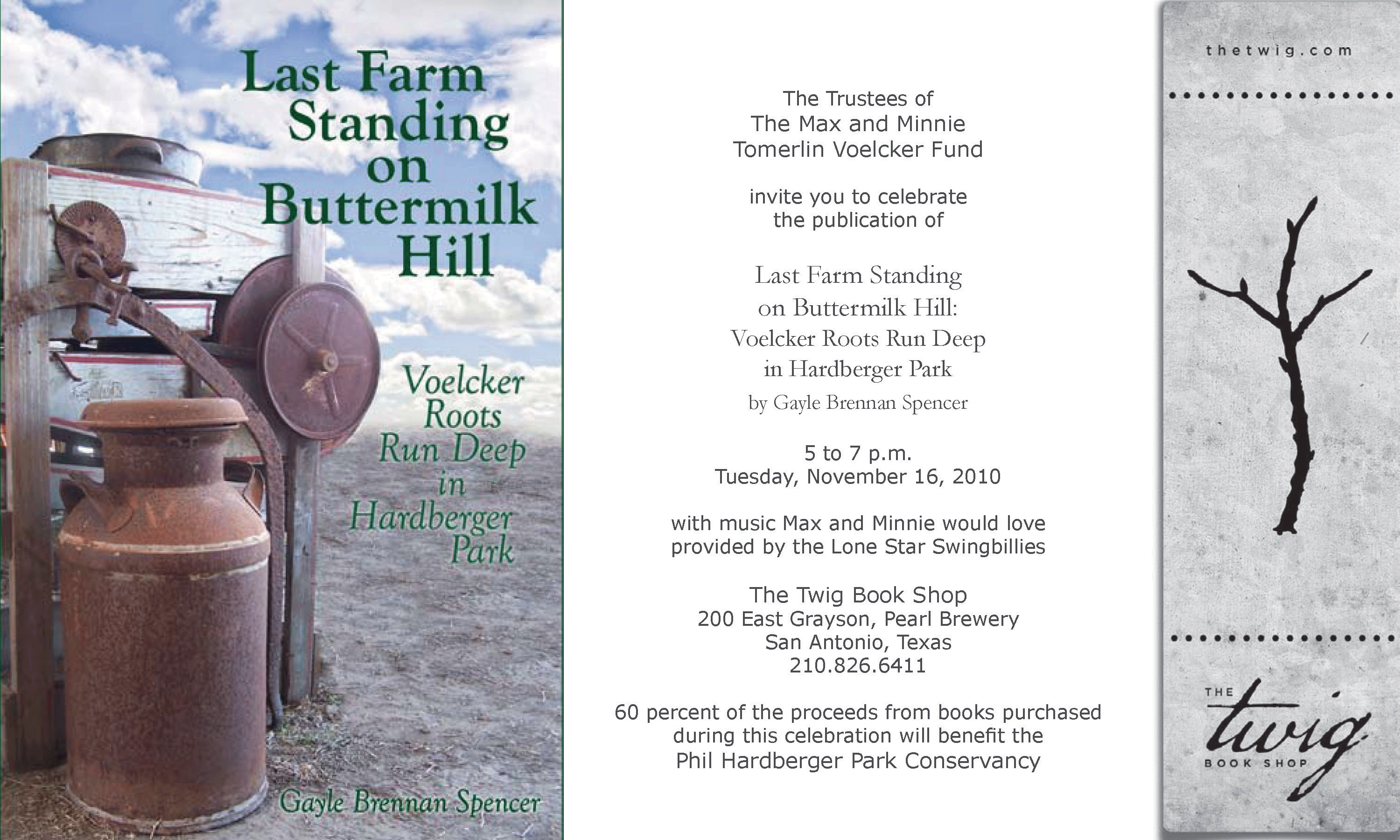
After the Texas Revolution, land grants from the Republic of Texas attracted new settlers to the outskirts of San Antonio.  The grandparents of Max and Minnie Tomerlin Voelcker were among those drawn by “gold” to a community known as the Coker Settlement, just north of today’s Loop 410 but, at the time, a full day’s round-trip by wagon on bumpy dirt roads. Unlike that of California, their gold was, first, the opportunity to produce golden butter and, later, the value of the land itself.

By the late 1800s, so many dairies dotted the countryside that the area became known as Buttermilk Hill.  Last Farm Standing on Buttermilk Hill traces the early migration to this community and the daily challenges faced by those who farmed the land.  Dairy farming involved rising before dawn to churn milk drawn the night before into butter, answering the twice-daily calls from cows in need of milking and driving long distances to deliver cream and butter to city-dwellers.  Life was not easy, and nature did not always cooperate.

Max and Minnie both were born on Buttermilk Hill and learned to milk cows almost as soon as they could walk.  With farming in their blood, they naturally married from within the Coker settlement.

As dairy farming became big business in Texas, small dairies no longer could compete.  But by then, the land itself was so valuable protracted court battles embroiled the Voelckers and their siblings, leaving permanent scars. San Antonio swallowed up one farm after another, until the Voelcker farm, part of which is Phil Hardberger Park, was the last one standing on Buttermilk Hill.

Update on November 9:  Unused, there are no remnants of cream glopped onto the back of this wonderful milk bottle cap Carolene dropped by my house.  She says (see her comment below) the Twilite Dairy was located out Blanco Road about a mile past Voelcker Lane.  That dairy on Buttermilk Hill, which no longer stands, had been owned by Josephine and Onis Lester Harrison (1910-1954), the son of Nancy Cordelia Tomerlin Harrison (1889-1962),  Minnie Voelcker’s half-sister.

Update on November 14Ed Conroy’s review in the Express-News is better written than the book itself.

Blogger’s Post Fans Memories of The Flame Room

David McLemore has a great post on Hot Wells

On adventurous evenings, we used to head south to the bar there, named The Flame Room because of the fire that had destroyed much of the former resort.   The woman behind the bar would come “entertain” you by making a tacky, spindly-legged bird marionette dance.   Ahead of fashion trends, the muscular carnival workers who wintered on the grounds sported intimidating tattoos. 

We played shuffleboard*, sat on the circular sofettes, tried to inconspicuously observe the unusual clientele and drank longnecks until forced to make the dreaded trek to the facilities.  While the men’s room was under a huge propeller conveniently adjacent to the bar, the ladies’ room required a journey down a long hallway past opening after opening of the dark ruins of private bathing rooms that certainly seemed haunted.  The sulphur smell from the pool was almost overwhelming.  We always went in pairs, too frightened to try to reach the lone dangling lightbulb at the end of the hall alone.   One night, Annie and I had almost reached our destination when, “Boo!”  That’s all the haggard woman screamed when she jumped out from one of the doorways, but we screamed as though she were a chupacabra.

Another night we came out to find out someone had carelessly crunched the bumper of their pickup through the front grille of our Volvo.  Thinking of the muscular tattooed arms inside that far outnumbered ours, we elected not to go back into The Flame Room and demand to know who hit our car.

The connection of Otto Koehler to Hot Wells David mentions is one of several reasons my novel about the brewer’s murder is called An Ostrich Plume Hat.  An in-depth history of Hot Wells can be found on the Edwards Aquifer website, from which I plucked this card.

Although I would be much too chicken to cross it, I wish a swinging bridge like the original one linking Hot Wells to Mission San Jose could be installed as part of the San Antonio River Improvements Project.

*Help!  It’s not called shuffleboard.  Long raised table-alley that you apply sawdust to and push these sort of pucks down to knock other pucks off the table….?

Note Added on September 17:  Also visit David’s article on Nowcast, a slide show and Charlotte-Anne Lucas’ video.  And more Hot Wells photos.

The Mystery of the Missing State Park

Whatever happened to your park, Hallie Maude Neff?

The newspapers of the day used such glowing terms to describe the new state park off the Boerne-Blanco Road (474) on the banks of the Guadalupe River.

Curiosity about the business partnerships existing between Albert Kronkosky, Charles Graebner (Albert Kronkosky’s brother-in-law?) and my husband’s step-great-grandfather, John Nooe (1871-1944), a doctor in Boerne, led me to the first clues of the existence of the park:

A beautiful park site at Boerne, eight miles from the Guadalupe river, donated to the State by Charles Graebner, Albert Kronkosky and Dr. J. F. Nooe, has been christened Hallie Maude Neff State park, In honor of the governor’s daughter.

The Brookshire Times, July 25, 1924

Following, is a list of parks given the State on the recent trip… Boerne, 50 acres, Charles Graebner, Dr. J. F. Nooe, Albert Kronkosky, on Guadalupe River, fine shade-and water. (Hallie Maude Neff State Park.)

San Antonio Express, August 19, 1924

The Hallie Maude Neff State Park at Boerne. which was donated by Messrs Albert Kronkosky, Dr. J. F. Nooe and Col. Chas. Graebner, will be one of the most attractive spots in Texas for the coming season, because it has the Guadalupe River for the north line and the Sabinas River running through it with a concrete dam across it, making a fine swimming pool or lake. We should say, that will accommodate 7,000 people.  This Park will attract thousands of people from San Antonio during the summer season.  The Chamber of Commerce at Boerne has raised funds by public subscription to build a better road to the Park and it is about completed now, it isn’t only a better road but a good one.  Thanks to Mr. Holekamp for his business methods in spending money.

Big Spring Herald, January 16, 1925

Had I stumbled across these clues in the mystery of the missing state park a number of years ago, perhaps Bessie Mae Kronkosky might have been able to shed light.  But she passed away on the first of this month at the age of 103  (And, not realizing until reading her obituary that Bessie Mae’s maiden name was Dever, I wish I would have known to inquire as well if she was somehow related to Minnie Tomerlin Voelcker, whose brother’s uncommon first name was Dever.).

Sarah Reveley shared a much larger clue with me, a full-page story praising the park as a “new fairyland” in the March 22, 1925, edition of the San Antonio Express:

For not only has one of the most alluring and naturally beautiful scenic spots of all Texas, or anywhere else for that matter, been given in fee simple to the State Park Board acting in behalf of the State of Texas, but now the same interest that gave the 70-acre tract eight and a half miles out the Blanco highway from Boerne are spending $15,000 from their private funds in order that the park will be ready to receive visitors early this summer.  Other citizens of Boerne recently subscribed $1,100 to provide funds for putting the highway from Boerne to the park in the best possible shape to accommodate the tremendously heavy traffic anticipated.

The article describes a lodge capable of accommodating 100 people next to the caretakers’ cottage and facilities for campers.  Among the distinctive features were a “babbling brook,” a “bell-ringing rock” and “the Flapper’s Roost, which is reached by a winding stair on a tree that leads from a cliff down to the water’s edge.”  Recreational opportunities included the swimming area in the Guadalupe, canoeing and a concrete dam being built over the Sabinas River for fishing.  The natural cave on Bear Creek in the park contained:

…the Venus hair fern, a species of Maidenhair fern scientifically know as Adiantum Cappillis-Veneris.  This is the only place in Texas that this specimen of fern is known to thrive.

Does this rare fern still thrive today?

I dragged one of my sisters out to look for the park that promised to attract San Antonians by the thousands.  The spot at the creek at what would have been the closest edge of Hallie Maude State Park to 474 is indeed still beautiful.  Although there is river access, no evidence of a state park exists.

But how did Hallie’s namesake park disappear from the Texas state map?  Please send more clues….

Note Added on September 13:  And how could it disappear so quickly? It does not appear to be included on a 1936 map of state parks published by the Texas Planning Board.

Note Added on September 15:  As this story wandered around the internet, it fell into the hands of Bill Ward, a retired geologist and member of the Native Plant Society.  Not sure why, but, according to his research, the “fairyland” was returned to its donors before 1933:

Most of the improvements at Hallie Neff State Park at Boerne came during 1926 through convict labor.  Footnote:  The seventy acre Hallie Neff Park was donated to the state in 1925. It reverted back to the donors before 1933. Charles S. Potts, The Convict Labor System of Texas. (Publications of the American Academy of Political and Social Sciences, No. 383, 1903), p. 429, U.T. Vertical File, Box 332, SHRLRC; “Eight Convicts and Truck to Help Neff Build State Parks,” Austin American. 1924, Box 3L426, CAH; Lawson, “The Texas State Parks System,” pp. 1-3; Jackson, “State Parks for Texas,” p. 71; Texas Legislative Council, Texas State Parks, p. 2.  page 41 of dissertation on Texas state parks

Note added on October 27:  Another update from Bill Ward –

Sabinas River refers to the little Sabinas Creek that enters the Guadalupe River just west of the 474 bridge.
That species of maidenhair fern is the most common fern in the Hill Country.  Even in 1925, no one should have said it only was known from that site.
Note Added on January 29, 2012: Could the fate of another Kronkosky generation’s donation of land for a state park be in jeopardy as well? According to the San Antonio Express-News, the state’s budgetary woes are stalling the development of a new state park on Highway 46 west of Boerne on more than 3,000 acres of land given to the state by the Kronkosky Foundation. The history-repeating-itself story even features a photo of a maidenhair fern.