The Howard Cemetery: Storage for old souls and old sofas

Such a peaceful, magical place. An appealing invitation to spend an eternity there. Hidden from cars traveling the Old San Antonio Road. Nestled in a thick cedar patch providing restful shade. Protected by a wall of stones quarried on the ranch and topped by jagged honeycomb rock.

It was a place I wanted to rest.

Before my father-in-law broke the news to me: the original Howard Cemetery deed restricted any increase in population in their cemetery to direct descendants and their spouses. I was crushed they would not accept the company of even their cousin Spencers. I considered leaving instructions for my ashes surreptitiously to be scattered among the graves.

Why would I want to end up somewhere uninvited? A spot so purposefully restricted to keep some late-arrival import, such as a Brennan, out?

After all, those who reside there are not mere Howards. They are Howard Howards – really Howardly – originally from King’s Stanley, Gloucestershire, England.

For the answer, refer to paragraph one.

But that temptation is gone.

After visiting the Howard Cemetery yesterday – no easy task – I particularly was struck by an article on the Herff Farm in today’s Rivard Report. The efforts of the Cibolo Nature Center to preserve the Herff farmhouse amidst Boerne’s explosive growth are so needed. The Herffs and the Howards were neighbors.

There will be no explosive growth in the Howard Cemetery because there are no direct descendants remaining anywhere nearby. When “Aunt Minnie,” Minnie Knox Spencer, born in 1883 in Galveston and only eligible by her marriage to Fitz-Alan Forester Howard (1878-1956), became a permanent resident of the cemetery in 1972, she left no direct descendants. I just missed getting to know her, much to my loss. Despite coming out of the Hutchings of Galveston and marrying into the Howard-Howards, Aunt Minnie evidently was down to earth. She could care less about money; she cared more for her goats.

The 280 acres of the Howard Ranch were divided among grand nieces, nephews and their children – meaning tracts as small as seven acres a piece, for which all were grateful. But that fragmentation eventually led to the demise of a bucolic tract of land.

This slideshow requires JavaScript.

And the cemetery, although restful within its walls, is now an isolated oasis in a sea of concrete. Swallowed by Boerne’s growth. By people who, like many of us, have more stuff than they need. People who have so much stuff, they rent storage. And people with major recreational vehicles in need of a place to rest.

So now they rest next to the cemetery. The cemetery encircled by concrete and yellow tape. Like crime tape confessing to the concrete sins.

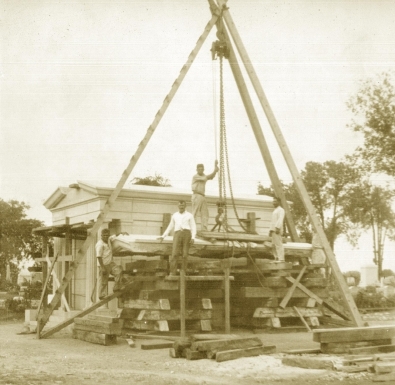
While the current owner was required to keep the cemetery, keeping the original main house – Ten Oak Hill Cottage – of John Howard Howard (1834-1894) was certainly not mandatory. But the owner of the Ten Oaks Storage Unit in Boerne did. Mercifully. There amidst the rows of metal sheds, it stands. Out of place, yet preserved.

A sliver of history that makes one mindful of the importance of the larger slice saved by the Cibolo Nature Center.
Haunting the graveyard to unearth the past

The pains of death are past.

Labor and sorrow cease.

And life’s long warfare closed at last.

His soul is found in peace.

Headstone of Joseph Coker, 1799-1881

One day I found myself, sitting in the middle of the carpet surrounded by boxes stacked in an attorney’s office on the 30th floor, rooting through another woman’s purse.

This really was not a planned direction for my career, but, undisciplined, I have always let it take numerous unscheduled detours.

I wanted the vintage pocketbook to spill the story of Minnie Tomerlin Voelcker out on the floor in front of me. Although its contents provided tiny glimpses of her personality, it was going to take a lot more time and effort to flesh out her and husband Max. Thanks to the Max and Minnie Tomerlin Voelcker Fund, I devoted two years to getting acquainted with the two hardworking dairy farmers who reside in the Coker Cemetery, resulting in the publication of The Last Farm Standing on Buttermilk Hill: Voelcker Roots Run Deep in Hardberger Park.

The Voelckers’ farm was part of a community of dairy farmers clustered together just north of Loop 410 in San Antonio. These families were unified by school, church and graveyard into a tightly knit community – the Coker settlement, and the Coker Cemetery Association plans to reunite these families in a book.

This slideshow requires JavaScript.

Farewell, my wife

and children all,

From you a Father

Christ doth call.

Headstone of James J. Tomerlin, 1858-1896

As the Voelckers did, many of these hardworking farmers retired to the Coker Cemetery. I went to visit them recently, hoping they would whisper tales to me.

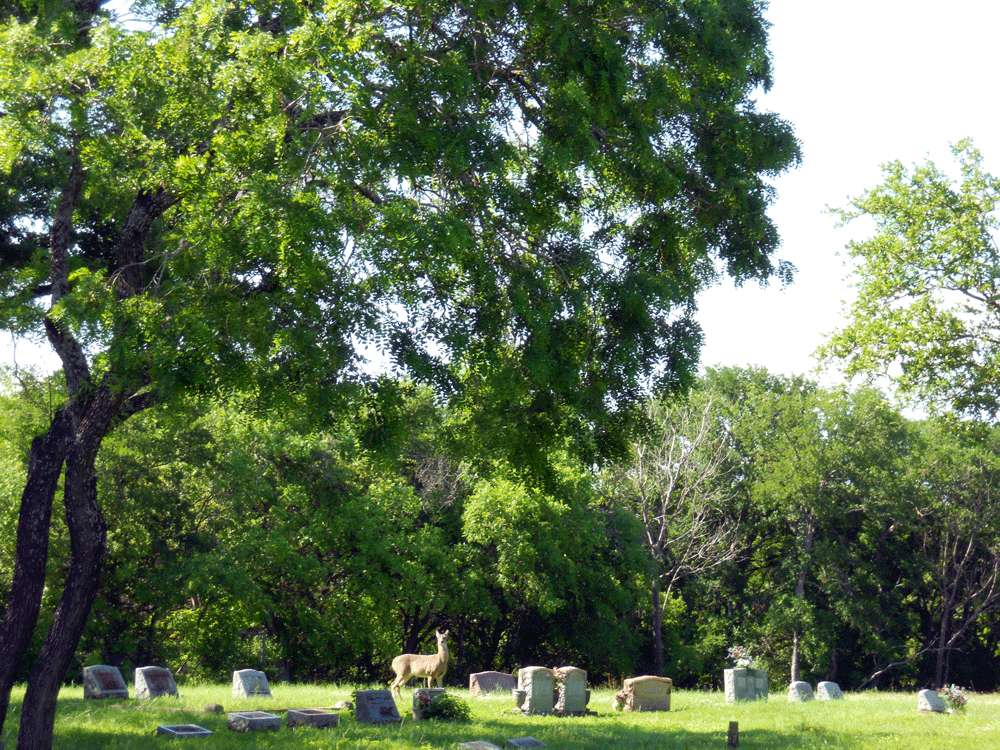
The jarring sounds of bulldozers working on the new portion of Wurzbach Parkway crashing through the former farms at first spoiled the peacefulness. But the spirits in this bucolic setting gradually quashed the intrusive noise, leaving me and several deer free to wander in the past.

The hours spent in the Coker Cemetery revealed some of the names of the farming families populating the settlement: Coker, Gerfers, Hampton, Harrison, Jones, Marmon, Smith, Tomerlin, Autry, Dekunder, Gulick, Harper, Isom, Maltsberger, Pipes, Tomasini and Voelcker. While their dairies in the area known as Buttermilk Hill were swallowed by behemoth San Antonio, the nonprofit association maintaining this historical cemetery knows their stories merit preservation.

As families dispersed from farms, remnants of the area’s history scattered with them. The Coker Cemetery Association asked me to bring these back together as a gift to the descendents of all who rest under the tombstones behind the old Coker church.

Charged with weaving bits of historical information together to illuminate this oft-forgotten portion of San Antonio’s rural heritage, I find myself again looking for chards. A page recording births and weddings in a family Bible. A brand registration from the late 1800s. A class photo from the old Coker schoolhouse. A tax return from the 1920s. A long-forgotten diary or letters tucked away in a shoebox. Memories grandparents shared about families’ arrivals in San Antonio or life on the farm.

I am asking descendants to introduce me to their ancestors from the Coker community, to search their studies, basements and attics and dust off the cobwebs in their minds to share memories and artifacts for this project. To ensure their ancestors are:

Gone but not forgotten.

Headstone of Rebecca Ford, 1823-1881

Thank goodness for detours, always full of unexpected opportunities and discoveries.

Marked Un-Graves Haunt Morning Walks

I know whom I am supposed to be researching:  The large and unwieldy cast of characters living in San Antonio between 1910 and 1920 whose stories seductively slip their way into the pages of An Ostrich Plume Hat whether they forward the plot or not.  Their ever-present ghosts float above my desk, my bathtub, my pillow at night, beckoning me to resurrect their lives on paper.  

The last thing I need is the distraction of unrelated people haunting me.  Blame it on the failure of native grasses to take root quickly on the Mission Reach.  If the construction workers or stray dogs guard the entrance by Roosevelt Park, I am forced to cross Roosevelt to South Presa.  

And there they are.  Their names prominently etched in stone disembodied from any gravesites.  

Who are they?  I worry they are not resting in peace but lying lonely underground in unmarked paupers’ graves.  

Did ungrateful descendants collect their inheritances and then decline to pick up the tabs for their headstones?  Or were they never real people, just imaginary inhabitants of San Antonio invented to serve as samples for those shopping for monuments to loved ones?  Or are they mistakes, large typos carved permanently in stone? 

From Meier Bros. Website


The latter two theories are more settling.  Meier Bros. Monuments has been in business for a long time, since 1900.  Surely the brothers have made a few spelling or date errors.  

But the names kept nagging me.  After all, Edna Viola Clift was someone’s “beloved grandmother.”  I owe her just a few short clicks on ancestry.com or in census records.  She did exist, dying in San Antonio in 1977.  Another woman was a longstanding member of St. Mark’s Episcopal Church, still living just a couple of years ago.  How did she end up carved in stone with only her birth date? 

His stone proclaiming “Dios es Amor,” Severo O. Cervantez was born in Mexico in 1887.  In 1910, he made his living in “cement work” and resided on Division Avenue with his wife Francisca and two-year-old son Geronimo, both native Texans. 

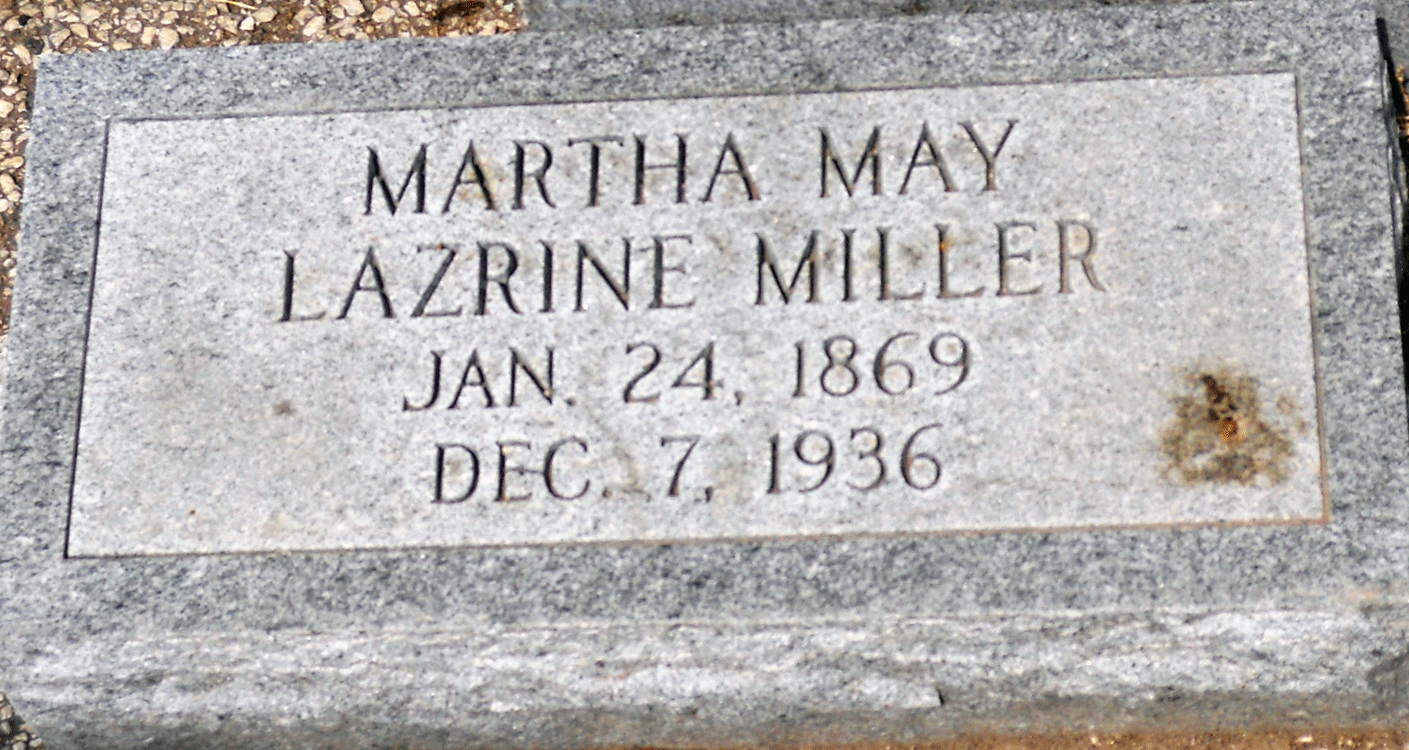
Mattie was the one, however, who finally freed me to resume contact with the ghosts entitled to haunt me.  The letters carved in granite read “Martha May Lazrine Miller.” 

Mattie was born in 1869 and married Lee, her senior by 13 years.  The couple raised at least seven children on their farm in Del Rio, Mattie’s mother residing with them, perhaps to lend a hand.  

In 1918, the 5’6.5″-tall Lee applied for a passport so he could board a ferry-boat to take one of his sons to spring baths in Las Vacas, San Carlos, Mexico, to cure his rheumatism.  Mattie and Lee now lie together in Del Rio’s Westlawn Cemetery with some other stone at their heads.  

Lee Lazrine's Passport Photo


Thank you, ancestry.com, for giving me the answer I sought.  A major typo.  

Martha May’s maiden name was Miller, and she married Lee Lazrine. 

Rest in peace, Mattie.
Time for me to get back to work.