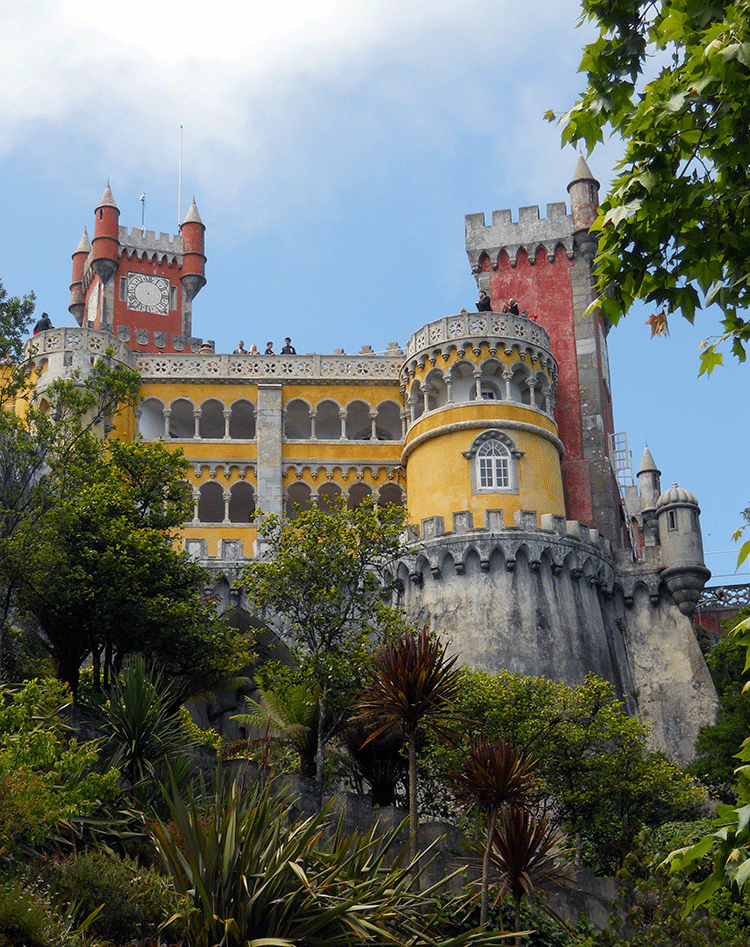
Postcard from Sintra, Portugal: The Opulence of the Pena Palace

Climbing up higher than the old Moorish Castle, one reaches a site where humble monks seeking an isolated retreat free from distractions established a monastery. Following the return of Vasco da Gama, King Manuel I (1469-1521) constructed a stone palace astride the hilltop as part of his celebration of Portugal’s vast new riches.

From 1840 to 1885, however, King Ferdinand II (1816-1885) transformed the Pena Palace into an overwhelming, over-embellished symbol of the aristocratic follies of European royalty (This was not the sole palace.) – a stunningly magical mélange of ornate Gothic, Renaissance, Moorish and Manueline architectural details.

This slideshow requires JavaScript.

Crumbling colonial power increasingly led to economic distress in the country, and King Carlos (1863-1908) resorted to dissolving the Parliament and assigning dictatorial powers to his prime minister. Discontent mounted, and brazen assassins fired into the open royal carriage as the King and his family traversed one of Lisboa’s main plazas. King Carlos and his eldest son were killed.

His second-born son, Manuel (1889-1932), succeeded him, only to be forced to flee to England in 1910. Manuel II was Portugal’s last king.

Amazingly, the leaders of the new republic preserved the palace and its lavish furnishings virtually intact.

Postcard from Lisboa, Portugal: Belem reflects the blessings bestowed by pepper

Arms and the heroes, from Lisbon’s shore, sailed through seas never dared before, with awesome courage, forging their way to the glorious kingdoms of the rising day.

The Lusiads, Luis de Camoes, 1572

Vasco da Gama sailed out of the Lisboa harbor in 1497 and would not return for more than two years. By then, he had lost half his fleet of four ships and approximately two-thirds of his men.

Yet his return was triumphant. His ships were laden with precious cargo, including ivory and prized spices, primarily pepper, from India. The cargo was valued at more than 60 times the cost of his expedition, and da Gama’s journey around the Cape of Good Hope proved for the first time the riches of India could be reached by sea. His trip poised Portugal to establish colonies all the way up and down both coasts of Africa and in Goa, India, which would remain under its domination for the next 450 years.

The golden age of Portugal was launched, creating a kingdom envied by royalty throughout Europe. In gratitude to da Gama and God and with the immense profits from pepper, King Manuel I (1469-1521) began construction of the massive Church and Monastery of Jeronimos at Belem. The ornate architectural style featuring elaborate stone carvings reflecting the country’s seafaring dominance and global influences became known as Manueline.

This slideshow requires JavaScript.

The style also is evident in the nearby Belem Tower, built between 1515 and 1520 to protect the harbor from invaders. Vasco da Gama sailed past it on his last voyage to Goa to serve as viceroy in 1524, but he died of malaria shortly after his arrival. His remains later made his final trip past the Belem Tower on the way to interment in a place of honor in the Church of San Jeronimos.