Postcard from Lisboa, Portugal: Rising from Rubble

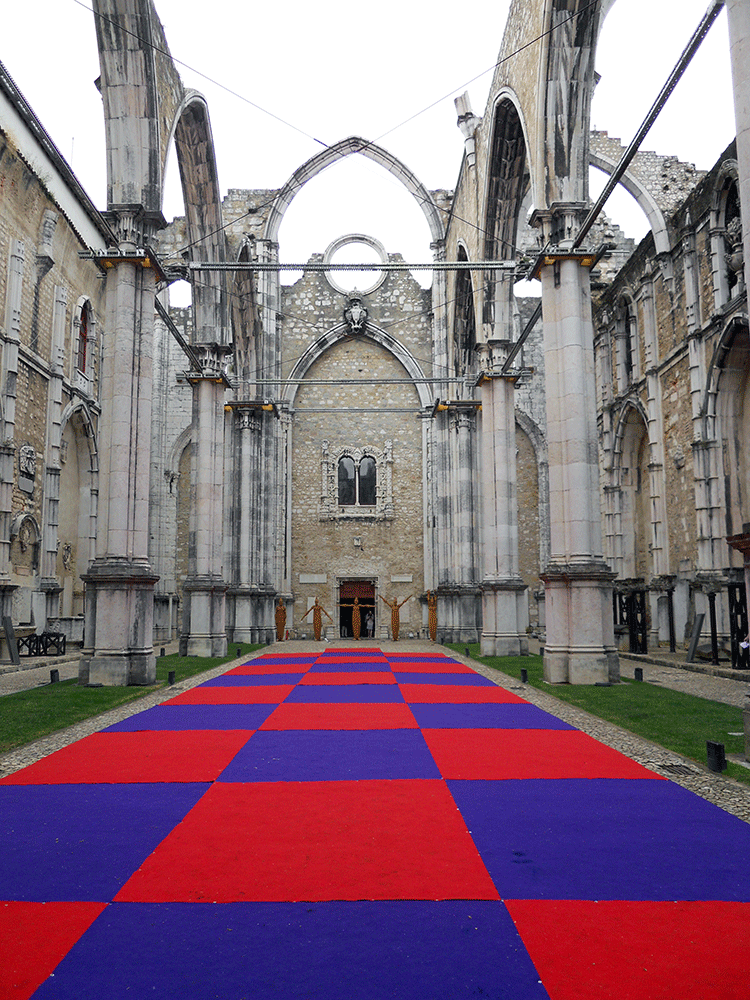
While there are ancient castles, churches and convents, some dating from as early as the 11th century, much of Lisboa is “new,” built after 1755.

On the morning of All Saints’ Day in 1755, Lisboa was struck by a major earthquake, one estimated to have been of an 8.7 magnitude. With towering church walls crumbling around them, many fled Mass for the safety of the riverfront, only to be swallowed by tsunami surges sweeping away broad swathes of the quay. Raging flames then began to leap from rooftop to rooftop throughout the city.

By the time the cascading disasters subsided, more than a quarter of Lisboa’s 250,000 inhabitants had perished. Most of the exquisite buildings dating from Portugal’s golden age lay in ruin.

The lower, center part of the city was razed. Sprawling networks of rabbit-warren streets were replaced by huge public squares connected by broad avenues. Elegant new buildings with earthquake-resistant walls began to line the boulevards.

This slideshow requires JavaScript.

Today’s Lisboa is vibrant and beautiful.

Postcard from Lisboa, Portugal: Belem reflects the blessings bestowed by pepper

Arms and the heroes, from Lisbon’s shore, sailed through seas never dared before, with awesome courage, forging their way to the glorious kingdoms of the rising day.

The Lusiads, Luis de Camoes, 1572

Vasco da Gama sailed out of the Lisboa harbor in 1497 and would not return for more than two years. By then, he had lost half his fleet of four ships and approximately two-thirds of his men.

Yet his return was triumphant. His ships were laden with precious cargo, including ivory and prized spices, primarily pepper, from India. The cargo was valued at more than 60 times the cost of his expedition, and da Gama’s journey around the Cape of Good Hope proved for the first time the riches of India could be reached by sea. His trip poised Portugal to establish colonies all the way up and down both coasts of Africa and in Goa, India, which would remain under its domination for the next 450 years.

The golden age of Portugal was launched, creating a kingdom envied by royalty throughout Europe. In gratitude to da Gama and God and with the immense profits from pepper, King Manuel I (1469-1521) began construction of the massive Church and Monastery of Jeronimos at Belem. The ornate architectural style featuring elaborate stone carvings reflecting the country’s seafaring dominance and global influences became known as Manueline.

This slideshow requires JavaScript.

The style also is evident in the nearby Belem Tower, built between 1515 and 1520 to protect the harbor from invaders. Vasco da Gama sailed past it on his last voyage to Goa to serve as viceroy in 1524, but he died of malaria shortly after his arrival. His remains later made his final trip past the Belem Tower on the way to interment in a place of honor in the Church of San Jeronimos.

Postcard from Lisboa, Portugal: Dreams of eternity etched in stone

DSCN0822

A bookworm’s dream. Bound for eternity with book in hand.

DSCN0819

Or perhaps a book in hand and an adoring dog at your feet.

DSCN0821

Doggie heaven. A fresh fowl ever ready everyday.

DSCN0820

Alas, the curse of a king. Forced to keep sword in hand and faithful hound ever vigilant until kingdom come.

DSCN0906

Or eternally wait for an answer from God.

DSCN0868

Or the poor saint who is given no rest. Her work on earth still in demand. Saint Justina, chastised for chastity and Catholicism. A recipe destined for martyrdom. Beheaded in the year 304, the rest of you unearthed and removed by papal politics some 1,500 years later for veneration by the faithful in Lisboa, far away from your Basilica in your native Padua and leaving the residents of Padua without the protection offered by the potent physical presence of their patroness.

I have no worries of being publicly preserved for prayers from the faithful. Sainthood passed me by at an early age.

But, if it’s at all possible to be buried with book in hand, please make it a well-loaded Kindle.

And, maybe, just let Howie rest in peace wherever he lies.