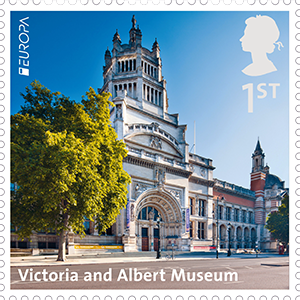
Postcard from London, England: Journeying inside the V&A

Above: Reflections in the viewing mirror installed above the Ardabil carpet, a commission for the ruling Shah of Iran made by Maqsud Kashani about 1540

One of the most popular spots in the Victoria and Albert Museum is the long sofa next to the ancient Ardabil carpet. While the rug’s design is exquisitely executed with about 3,500 wool knots per square inch, for many, the bench is the main attraction. Ah, the chance to reflect and rest. We were fortunate to have the time to visit more than once during our stay.

It’s easy to be bowled over by the swirling, shimmering colors of Dale Chihuly’s immense contemporary glass chandelier suspended under the graceful dome of the grand entrance hall to the museum. The sheer size of the 1862 iron choir screen from the Hereford Cathedral addressing the space competes for your attention.

Continue reading “Postcard from London, England: Journeying inside the V&A”

Postcard from Lisboa, Portugal: Belem reflects the blessings bestowed by pepper

Arms and the heroes, from Lisbon’s shore, sailed through seas never dared before, with awesome courage, forging their way to the glorious kingdoms of the rising day.

The Lusiads, Luis de Camoes, 1572

Vasco da Gama sailed out of the Lisboa harbor in 1497 and would not return for more than two years. By then, he had lost half his fleet of four ships and approximately two-thirds of his men.

Yet his return was triumphant. His ships were laden with precious cargo, including ivory and prized spices, primarily pepper, from India. The cargo was valued at more than 60 times the cost of his expedition, and da Gama’s journey around the Cape of Good Hope proved for the first time the riches of India could be reached by sea. His trip poised Portugal to establish colonies all the way up and down both coasts of Africa and in Goa, India, which would remain under its domination for the next 450 years.

The golden age of Portugal was launched, creating a kingdom envied by royalty throughout Europe. In gratitude to da Gama and God and with the immense profits from pepper, King Manuel I (1469-1521) began construction of the massive Church and Monastery of Jeronimos at Belem. The ornate architectural style featuring elaborate stone carvings reflecting the country’s seafaring dominance and global influences became known as Manueline.

This slideshow requires JavaScript.

The style also is evident in the nearby Belem Tower, built between 1515 and 1520 to protect the harbor from invaders. Vasco da Gama sailed past it on his last voyage to Goa to serve as viceroy in 1524, but he died of malaria shortly after his arrival. His remains later made his final trip past the Belem Tower on the way to interment in a place of honor in the Church of San Jeronimos.