Postcard from Porto: Parting Shots

The mood of Porto varies in accordance with the sun and the rain. On days when the sun is absent, the gray granite tinges the city with sadness. I take on the color of Porto each day. When there is sun, Porto awakes as cheerful as a teenager. The light of Porto is a warm yellow that penetrates the bodies of those who stand at the window. I was born and still live close to the sea. I don’t know how else to live. At the moment, I am living in Foz Velha, at the mouth of the river. There is a broad promenade facing the sea and lower, close to the beach, esplanades are open all year round. My life consists of rocks, sand, sea, and gulls. There I am, and the image of myself that I carry with me wherever I go.

Rosa Alice Branco

interviewed by Nathalie Handal on Words Without Borders

The weather in Porto is noted for being moody. Mercurial. Dictated by whatever the Atlantic sends its way.

As someone whose spirits are affected by dreary weather, the maritime gods bestowed their mercy upon me while we were there. In fact, the climate during our two-week stay was so sunny and temperate, I felt I could live there forever. Sometimes in the late afternoon, we would see semi-threatening gray clouds accumulating along the Atlantic shoreline. But the ridge stopped there, never rounding the bend into the mouth of the Douro River.

So we walked and we walked. Wending our way through layers of history built up over centuries. Up and down. Along both sides of the Douro. Crossing a bridge and even taking a ferry across. Here are some parting shots from our stay.

This slideshow requires JavaScript.

Postcard from Porto: Digging deeper than the Ribeira

Time hangs in Porto. Its magnificently lingering melancholic soul, floats. The past and the present forget themselves here….

Porto alters your perception. And you allow it because you want its light in your eyes, its breeze to descend slowly into your mind. Arrest you. Like a book you are trying to finish but refuse to, it’s so captivating.

Nathalie Handal on Words Without Borders

First impressions run deep, so throw out the guidebooks telling you to head for the Ribeira district in Porto. The riverside promenade fronting 14th-century wine cellars in the shadow of the soaring 1880s’ wrought-iron bridge spanning the Douro River sounds ideal, but only if your ideal is to wander among other tourists stopping at cafes existing only for them and a jumble of junky shops selling only the most stereotypical Portuguese souvenirs. If the Ribeira had been my first walk in Porto, I would have wanted to hop the next plane or train out.

But it wasn’t. Suffering with the unavoidable cross-Atlantic jet lag, we stumbled out of our apartment down to the riverside, landing on a promenade away from most tourists. As we headed toward the center of the city, we found a rhythm in sharing space with fishermen, walkers, joggers, bicyclists, seagulls and the occasional trolley. The hills rising from the river were filled with tile-roofed houses, tile-sided residences, churches and new apartments and condominiums – layers of centuries of history demanding attention everywhere we looked. I fell in love immediately.

This post represents some random shots from our Porto explorations.

This slideshow requires JavaScript.

We’re used to daily river walks in San Antonio, but I must confess the Douro is a bit grander in scale. When we wander the other direction riverside, we encounter even fewer people who are not local. Jetties and a castle guard the harbor of the Douro from the Atlantic. Rounding that corner, you are slapped by stiff ocean tighten-the-stampede-string-on-your-hat breezes.

Downtown Porto has neighborhoods crisscrossed with streets barely wide enough for even the “Smartest” cars and wide boulevards lined with elegant structures equal to those in most European capitals. Restaurants and cafes are everywhere; just skip the ones along the Ribeira.

Postcard from Porto: The artistry of clean clothes

Americans. So puritanical.

Not only is airing our dirty laundry frowned upon, we also seem opposed to airing our clean laundry. We banish the entire function to closeted quarters hidden from guests.

Dryers further protect our privacy, as though naked underthings are far too revealing. Forget preserving our resources by relying on wind-power instead of electricity. We’d never think of hanging wet clothes out to dry on the front porch. Subdivisions often forbid even backyard clotheslines.

As a result, we are fascinated by the flagrant displays of clean clothes hung in full view in other countries. I try to refrain from framing photos of colorful wardrobes flapping in the breeze, but sometimes I slip into this silly form of voyeurism transforming the appearance of even drab building facades into changing kaleidoscopes of color on a daily basis.

This slideshow requires JavaScript.

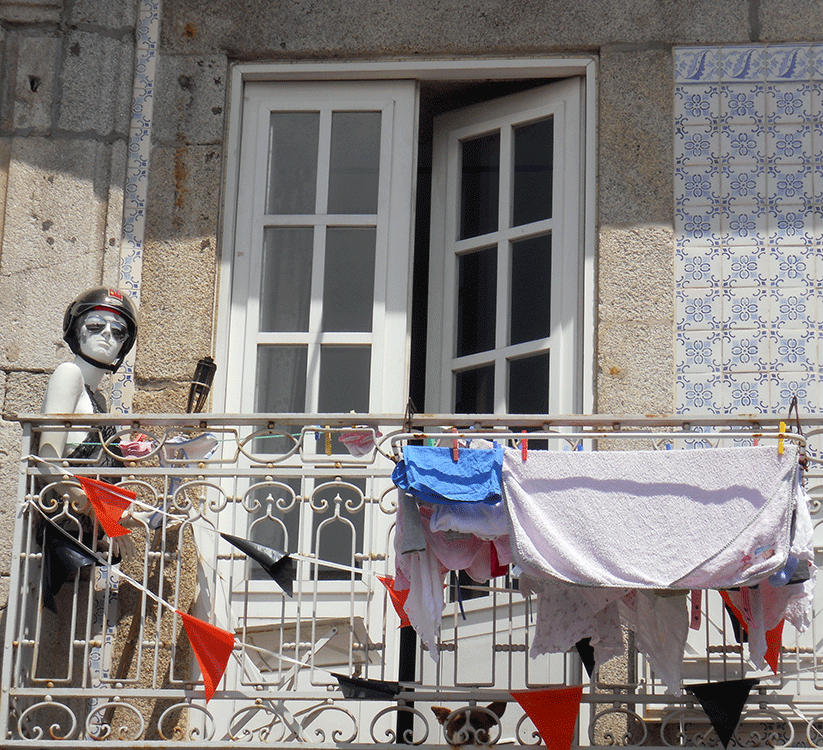
Laundry hangs everywhere in Porto – over the heads of diners on a narrow street, flapping amidst festival flags on another, constant reminders that everyone puts their pants on the same way.

My favorites on morning walks along the banks of the Douro River are those artistically arranged for the entertainment of others – a mannequin for drying underwear or a pair of black undies pinned next to a tile saint.

Portenos are proud of their cleanliness. Only Americans treat laundry as though it were a dirty little secret.

Update Added on May 8, 2014: Oh, that we could add to the display, but, alas, we cannot. We took all our darks and loaded up the machine using the product with the pile of fluffy towels on the label, distinguishing it from the one with the stack of dishes on the label. Vocabulary Lesson 101: Lixivia means bleach. Hint: The towels on the label are white. Add to to-do list: Shop for black and navy tops.